This lesson helps us understand what an indefinite adjective is, how many indefinite adjectives we have in English, and how to use them in a sentence.
What is an indefinite adjective in English?
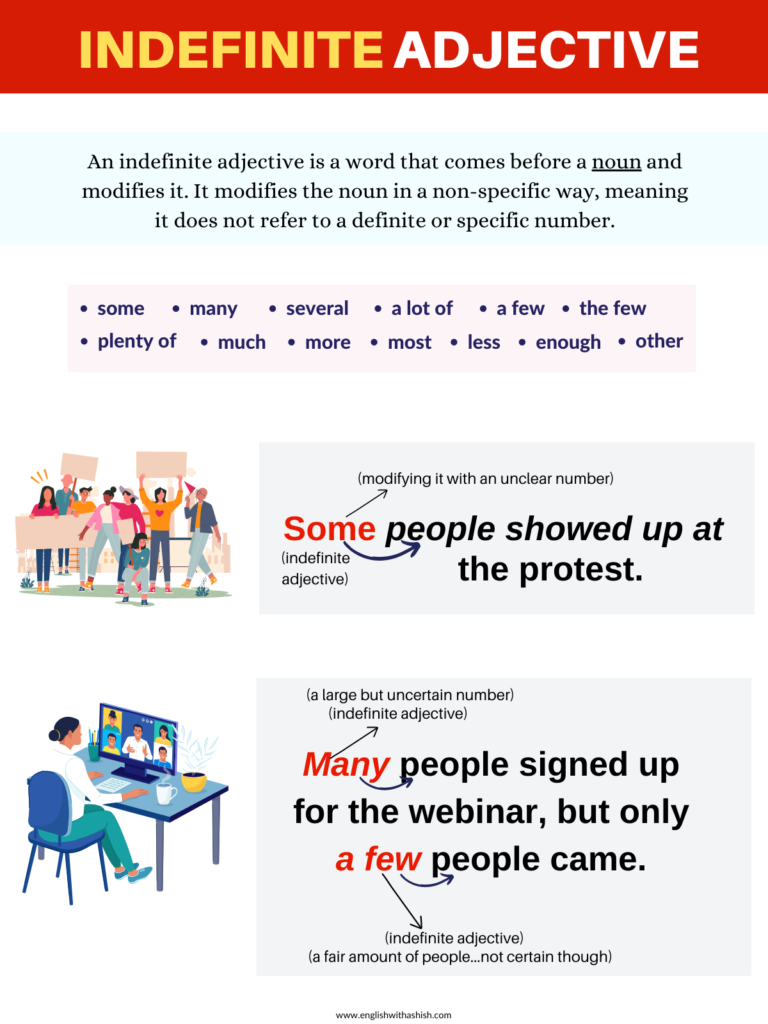
An indefinite adjective is a word that comes before a noun and modifies it. It modifies the noun in a non-specific way, meaning it does not refer to a definite or specific number or a description of a noun.
A list of indefinite adjectives in English:
- Some
- Many
- Most
- All
- Plenty of
- Much
- More
- Less
- A lot of
- A few/the few
- Several
- Various
- Enough
- Other
- Little/a little/the little
Some people from an NGO came to meet you at the office.
In the example, the word ‘some’ works as an indefinite adjective as it modifies the noun ‘people’. It refers to an indefinite quantity of the noun. The quantity it refers to is considered good.
I have been to many countries, but the diversity that we see in India is unparalleled.
The word, in this example, modifies the noun ‘countries‘ by defining it with an uncertain quantity. The word ‘many’ refers to a large number of something.
Examples of an indefinite adjective
- Some people never learn from their mistakes.
- Many people signed up for the webinar, but only a few people came.
- We still have plenty of options if this does not work out.
- All the decisions turned out to be wrong.
- There is not much food left for you.
- This guy has more money than he actually needs.
- Most people do not like to be abused.
- The shopkeeper showed us various designs of suits.
- Please leave. I need fewer distractions.
- You showed less confidence in the meeting.
- We had a lot of time to get there in time, but we still got late.
- There are several companies that are into skill development training these days.
- I have given you enough chances to correct the mistake.
- This one might trouble you on the trip. Use the other car.
Indefinite adjectives that are used with countable nouns
- Some
- Many
- A lot of/lots of
- Several
- Plenty of
- More
- Several
- A few/the few
- Fewer
- More
- Other
Indefinite adjectives that are used with uncountable nouns
- Much
- Enough
- Less
- Little/a little/the little
Examples:
- The pasta tasted great even without putting much cheese in it.
- She gathered enough courage to face her fears.
- I like to have less milk in my tea.
- Show me a little sincerity about the situation.
Indefinite adjectives that are used with both countable and uncountable nouns
- A lot of/lots of
- Some
- Plenty of
- More
- Enough
Examples:
- He has a lot of experience with this work. (uncountable)
- A lot of artists came in her support. (countable)
- You need to have some courage to get out of the situation you are in. (uncountable)
- After college, I used to teach some kids. (countable)
- You have got plenty of meat on your plate. (uncountable)
- They wrote plenty of articles about our company. (countable)
- There is more milk in the fridge. (uncountable)
- We still have more papers to go through. Hurry up. (countable)
- We have had enough fun. Let’s go home now. (uncountable)
- We have been given enough chances to prove our worth. (countable)
Please note that the nouns being modified in these examples are underlined.
lndefinite pronouns with usages
| Indefinite adjective | Usage | Example |
| Many | It refers to a large number of a plural countable noun. The focus is on the number or quantity being big. It is used with countable nouns. | 1. I have many teachers in my life, but I have never seen anyone like you. 2. There were many people in the hall when you called. |
| Some | It is used to modify both countable and uncountable nouns. When used to modify countable nouns, it indicates a number (of something) that is considered positive. | 1. I know some people who can help you. 2. I was really impressed by some students in section B. 3. Your brother called and asked for some money. 4. You need some experience before entering into this business. |
| All | It refers to whole quantity of what is referred to. | 1. All passengers are requested to not eat on the train. 2. The message about shutting down the business has been shared with all the employees. 3. All the cases filed against me are baseless. 4. All your problems go away when stop considering them as problems. 5. All rooms are booked at the moment. 6. Amongst all the candidates I have talked to so far, Samuel has the best skill set. |
| Several | It refers to an amount or number (of people or things) that is more than 2. It is used to indicate a positive quantity. It only modifies a plural countable noun. | 1. There were several incidents where he interrupted the speakers. 2. Ashish has given several speeches on the ‘power of the subconscious mind’. |
| A lot of/lots of | It indicates a large number or amount of something. It is used with both countable and uncountable nouns. | 1. He has a lot of experience to share. 2. Jon received lots of messages on his birthday. 3. We generate a lot of power from our hips. 4. My sister has got lots of perfumes. |
| Plenty of | It is used to refer to a sufficient or even more than sufficient amount or quantity of something. | 1. We are left with only a few options now. 2. I still had a few questions unanswered when the exam time was over. 3. I have a few suggestions for the committee. |
| A few | It refers to a small yet positive amount or number of something (countable). | 1. I know a few places where we shoot for the video. 2. The kids want to talk to you for a few minutes. 3. She always keeps a few chocolates in her purse. |
| Fewer | It indicates a smaller number of something (countable). It is used with only countable nouns. | 1. Fewer people have shown up to the meeting this time. It’s not a good sign. 2. We are in the perfect situation, but the good thing is that we have fewer distractions to deal with. |
| More | It means an additional amount of something (people or things). It is used with both countable and uncountable nouns. | 1. We need more people to pull off this project. 2. The boss has given us more work. |
| Most | It indicates the biggest amount/number of something. | 1. Most people never meditate in their lives. 2. I eat most vegetables, but I simply hate mushrooms. |
| Less | It indicates a smaller amount/number of something. | 1. I can survive with less money. 2. We have less water to drink. |
| A little | It indicates a small yet positive amount of something. It is used to modify uncountable nouns. | 1. We need a little help from you. 2. There is a little water in my bottle. You can drink it. |
| Much | It indicates a good or great (positive) amount of something uncountable. When it is used as an adjective, it is often used in negative and interrogative sentences. | 1. She is mad, for there is not much food left to eat. 2. There is not much money left in my bank after buying the house. 3. I don’t have much time for your stupid jokes. |
| Enough | It indicates an amount that’s enough or as much as necessary. It is used with countable and uncountable nouns. | 1. We have enough guys to pull this off. 2. She does not have enough money to buy a new car. 3. I am dealing with enough problems already; I don’t need another one. 4. You have done enough work today. Go home. |
| Another | It indicates an additional person or thing, whatever it’s modifying. It is used with countable nouns. | 1. No one wants to do another task. 2. You are getting another chance. |
| Other | It is used to indicate that a person or thing is not the same person/thing mentioned in the context or understood from the context. | 1. Have you met my other daughter? 2. Where is the other phone? 3. I have not brought the other man. |
Indefinite adjective vs indefinite pronoun
Most of the words in the list above can function as both an adjective and a pronoun. As a pronoun, they don’t take a noun after them and stand alone.
- I bought a lot of new pants last month for charity. I still have some with me. (indefinite pronoun)
- We are looking for some writers. (indefinite adjective)
- Thousands of people joined the protest in the morning at the TED Mall. Many of them are still there. (indefinite pronoun)
- I gave him many ideas to get rich. (indefinite adjective)
- There were over 200 guests. Several of them are still in the hall.
- Several people were fired last month.
- You can eat this. I have more.
- Give me more water.
Notice that when these words function as an adjective, they have a noun after them that they modify. And when they function as a pronoun, they refer to a noun and stand alone. The nouns that the indefinite adjectives modify in these examples are underlined.
Not all indefinite pronouns can function as indefinite adjectives
- Someone
- Something
- Anyone
- Anything
- Everyone
- Everything
- No-one
- Nothing
Examples:
- Someone came to see you at the office an hour ago.
- I have everything that I need.
- Nothing is impossible.
These are words that function as indefinite pronouns; they don’t function as adjectives. Don’t consider them an indefinite adjective.
An indefinite adjective in famous quotes
- “I’m selfish, impatient, and a little insecure. I make mistakes, I am out of control, and at times hard to handle. But if you can’t handle me at my worst, then you sure as hell don’t deserve me at my best.” ― Marilyn Monroe
- “So many books, so little time.” ― Frank Zappa
- “To live is the rarest thing in the world. Most people exist, that is all.” ― Oscar Wilde
- A rose by any other name would smell as sweet. ― William Shakespeare
- You will face many defeats in life, but never let yourself be defeated. ― Maya Angelou
- “Don’t be distracted by criticism. Remember — the only taste of success some people get is to take a bite out of you.” ― Zig Ziglar
FAQs
What is an indefinite adjective?
An indefinite adjective is a word that comes before a noun and modifies it with an unspecific quantity. Ex – We need some bikes. Ex – She has got a lot of money.
What are 3 indefinite adjectives?
Examples of indefinite adjectives:
1. Many students are in support of the teacher.
2. Do you have some milk?
3. There’s plenty of time to do this.
4. They are asking for more money.
Is more an indefinite adjective?
Yes, the word ‘more’ is an indefinite adjective. Ex – More people are needed in this department.
How do you use indefinite adjectives in a sentence?
Indefinite adjectives are used to modify a noun with an unspecific quantity. It comes right before the noun it modifies. Ex – Many people still believe in ghosts. Ex – We needed a little motivation to pull that off. Ex – You put a lot of sugar in the tea.
Have a question or need deeper clarity? Drop it in the comments — I personally answer your questions/doubts.
If you found this lesson valuable, share it with peers or learners who will benefit. Let’s raise the standard of how we learn English — together.
Looking for personalised coaching to elevate your English, communication, and life skills?
I offer 1-on-1 mentorship that integrates advanced English fluency with emotional intelligence, confidence building, and personality development — designed to help you grow not just as a speaker, but as a powerful individual.
Reach out at [email protected] to get started.
On YouTube and Instagram, we break down real conversations, dive into pop culture, share quick grammar hacks, and do the things your textbook never could.
Follow now — and start learning smarter.
