Welcome back to another lesson of English With Ashish.
In today’s lesson, we are going to master something powerful—something that will take your English to the next level: Reduced Noun Clauses.
In this article, we explore what noun clauses are, why and how they can be reduced, and the different forms they take. By the end, you’ll have a clear understanding of reduced noun clauses and the ability to apply them naturally in your own writing and speech.
What is a Noun Clause?
A noun clause is a dependent clause (cannot stand alone) that functions as a noun in a sentence.
Just like a noun, it can serve different roles:
- Subject of a sentence (What you said is true.)
- Object of a verb (I don’t know what he wants.)
- Object of a preposition (She is thinking about what she should do next.)
- Subject complement (The problem is that you don’t listen to anyone.)
- Sometimes object complement (We call her what she wants to be called.)
Noun clauses generally start with subordinating conjunctions such as:
what, that, who, whom, where, why, when, how, if.
What is a Reduced Noun Clause?
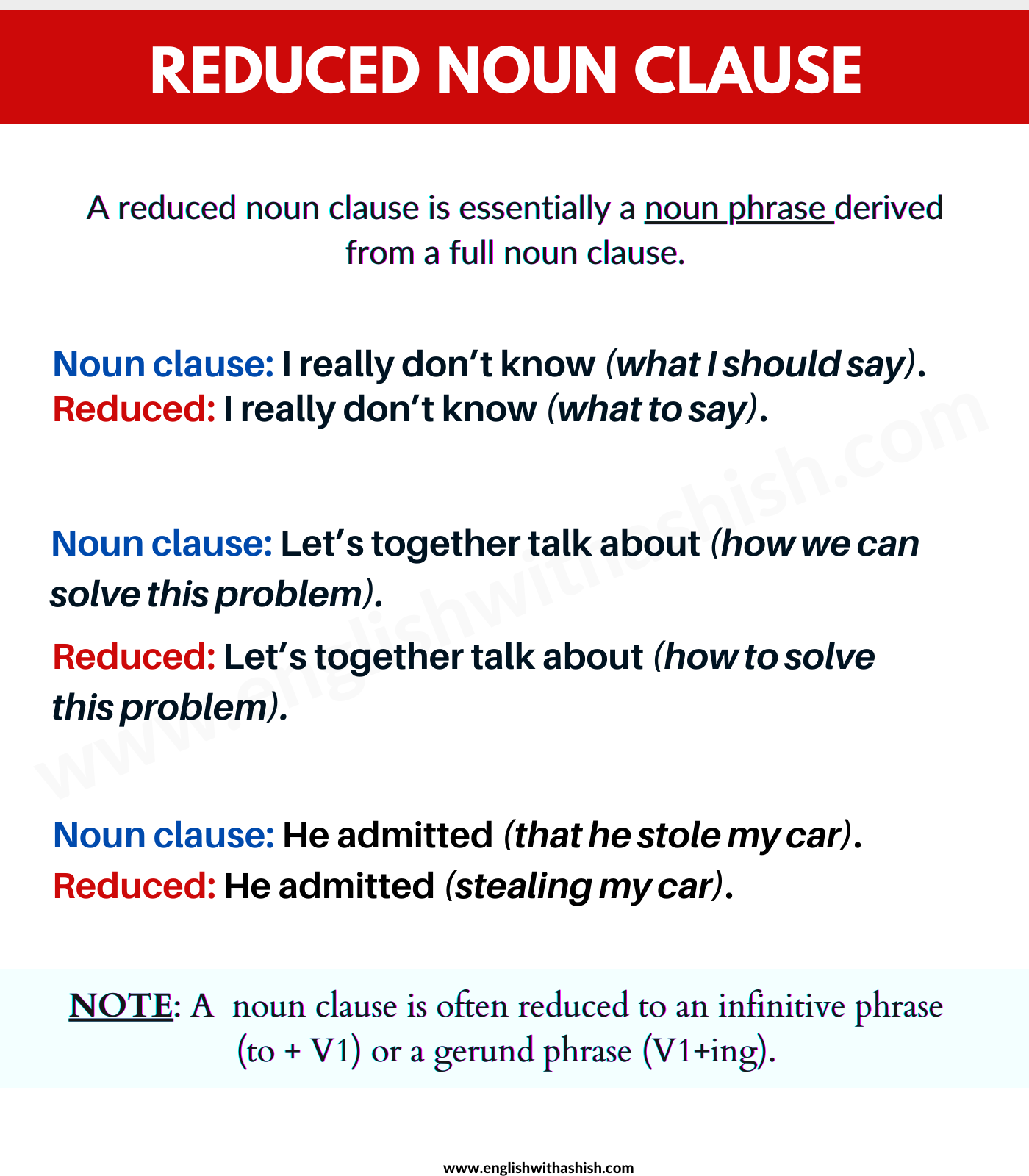
A reduced noun clause is essentially a noun phrase derived from a full noun clause. Instead of having a ‘subject + verb‘ structure, the reduced form typically becomes:
- an infinitive phrase (to + verb), or
- a gerund phrase (verb + ing).
How to Reduce a Noun Clause
Let’s learn how to reduce noun clauses into phrases.
1. Noun clauses reduction to infinitive phrases
This is the most common type of reduction. It happens when the noun clause contains modal verbs such as can, could, should.
Pattern:
Noun clause: subordinating conjunction + subject + modal auxiliary verb + main verb
Reduced infinitive phrase: subordinating conjunction + to + main verb
Examples:
Noun clause: I don’t know how I can get the job.
Reduced infinitive phrase: I don’t know how to get the job.
Noun clause: She told us why we should invite Ron.
Reduced infinitive phrase: She told us why to invite Ron.
Noun clause: He doesn’t know when he should call her.
Reduced infinitive phrase: He doesn’t know when to call her.
Noun clause: In the investigation, the accused claimed that he had murdered the man with a rope.
Reduced infinitive phrase: In the investigation, the accused claimed to have murdered the man with a rope.
Noun clause: You promised me that you will return my money by October.
Reduced infinitive phrase: You promised me to return my money by October.
In these examples, we have taken away the subject and the modal or helping verb, and then changed the main verb into an infinitive (to + verb). This way, the full noun clause becomes a shorter infinitive phrase, but the meaning stays the same.
2. Noun clauses reduction to gerund phrases
Sometimes, noun clauses can be reduced into gerund phrases. This usually happens when the verb expresses an action already done or admitted.
Pattern:
Noun clause: subordinating conjunction + subject + modal auxiliary verb + main verb + other parts
Reduced gerund phrase: gerund + other parts
Examples:
Noun clause: He admitted that he stole my car.
Reduced gerund phrase: He admitted stealing my car.
Noun clause: Rahul, the boss, often enjoys that he has to prove everyone wrong and work hard.
Reduced gerund phrase: Rahul, the boss, often enjoys proving everyone wrong and working hard.
Noun clause: She confessed that she cheated in the exam.
Reduced gerund phrase: She confessed cheating in the exam.
Noun clause: They acknowledged that they made a mistake.
Reduced gerund phrase: They acknowledged making a mistake.
Noun clause: I am not denying that I underperformed at the event.
Reduced gerund phrase: I am not denying underperforming at the event.
Noun clause: Love him or hate him, he has never mentioned that he was mistreated by you at work.
Reduced gerund phrase: Love him or hate him, he has never mentioned being mistreated by you at work.
Noun clause: Most people can’t stand that they are interrupted in front of others.
Reduced gerund phrase: Most people can’t stand being interrupted in front of others.
In these examples, we have removed the subject of the noun clause and changed the main verb into its -ing form (gerund). This makes the clause shorter while keeping the same meaning.
Notice when the verb of the noun clause is in the passive voice, meaning the subject of the main clause receives the action in the noun clause, we use the passive form of the gerund (being + V1+ing). The last three examples demonstrate that.
More Examples to Strengthen Understanding
| Full Noun Clause | Reduced Form |
|---|---|
| I don’t know what I should say. | I don’t know what to say. |
| She’s thinking about what she should do. | She’s thinking about what to do. |
| He admitted that he lied. | He admitted lying. |
| We discussed how we could solve the issue. | We discussed how to solve the issue. |
| What you decide will affect the outcome. | What to decide will affect the outcome. |
When reduction is not possible
A) Not all noun clauses can be reduced. If reducing changes the meaning of the sentence, it must remain in its full form.
Example:
- I know where he is hiding.
- I know where to hide. (Incorrect, different meaning)
Reduction works best when the clause expresses possibility, necessity, or ability (with modals) or when it is linked to actions that can be summarized with an infinitive or gerund.
B) It is important for the subject of the main clause and that of the noun clause to be the same to reduce noun clauses when they start with subordinating conjunctions such as what, when, how, why, and where . If they are different, reduction is simply not possible.
Let’s take some examples and observe it ourselves.
Examples:
- None of us really knows what Rahul should do right now to get out of this situation.
- I remember what he said last night.
- She forgot when they met her.
- They discussed how the company would solve the problem.
- We talked about why he chose this plan.
- He regrets where she parked the car.
In the above examples, the subjects of the main clauses and the noun clauses are different, and the noun clauses begin with subordinating conjunctions like what, when, why, how, or where. Because of this, reduction becomes impossible or ungrammatical.
NOTE: In cases where the noun clause has a different subject but starts with the conjunction ‘that‘, we can still reduced it to a noun phrase.
Let’s understand this better with some examples.
Ashish respects that his learners love him dearly.
Reduced noun clause: Ashish respects his learners’ loving him dearly.
I dislike that people waste so much food.
Reduced noun clause: I dislike people’s wasting so much food.
We appreciated that you helped us yesterday.
Reduced noun clause: We appreciated your helping us yesterday.
The teacher noticed that some students were talking.
Reduced noun clause: The teacher noticed some students’ talking.
They resented that the manager ignored their request.
Reduced noun clause: They resented the manager’s ignoring their request.
Important point to remember: when the noun clause describes a fact or static state, it is a little uncommon or unnatural to reduce it to a phrase.
I know that you are a liar.
Reduction: I know your being a liar.
She believes that honesty is important.
Reduction: She believes honesty’s being important.
They agreed that the plan is practical.
Reduction: They agreed the plan’s being practical.
More Structures to Reduce Noun Clauses
STRUCTURE 1: When the subject of the main clause is an object of the verb in the noun clause.
Noun Clause: Subordinating conjunction + subject + verb + object (subject of the main clause) + other parts
Reduction (gerund phrase): Being + past participle (V3) + other parts + by + subject
Example 1: Jon finally admitted that his sister helped him in the test.
Reduction: Jon finally admitted being helped by his sister in the test.
Example 2: I regret that the teacher stopped me from pairing up with you for the assignment.
Reduction: I regret that being stopped from pairing up with you for the assignment by the teacher.
Example 3: The poor hate that the society mocks and bully them for being poor.
Reduction: The poor hate being mocked and bullied for being poor by the society.
STRUCTURE 2: When the subject of the main clause is neither the subject or object of the noun clause
Noun Clause: Subordinating conjunction + subject + verb + object (subject of the main clause) + other parts
Reduction (gerund phrase): Subject + apostrophe + s (e.g. Jon’s) + present participle (V1+ing) + the rest of the clause)
In these sentences, the subject is kept with adding an apostrophe and ‘s’ (making it a possessive case) and verb is changed to a present progressive form irrespective of the form it is in.
Example 1: Jon finally admitted that Raveena ran with his brother.
Reduction: Jon finally admitted Raveena’s running with his brother.
Example 2: The teacher appreciated that Rahul completed the project on time.
Reduction: The teacher appreciated Rahul’s completing the project on time.
Example 3: I regret that Meera missed the opportunity.
Reduction: I regret Meera’s missing the opportunity.
Example 4: The police confirmed that Sameer stole the car.
Reduction: The police confirmed Sameer’s stealing the car.
Example 5: I didn’t mind that Neha arrived late.
Reduction: I didn’t mind Neha’s arriving late.
Notice that the noun clauses function as the object of the verb of the main clauses in the sentences.
Practice set!
Rewrite the sentences by reducing the noun clause into an infinitive or gerund phrase. The answers will be provided at the end of the post.
- I don’t understand why we should be upset.
- She explained how we should solve the problem.
- He admitted that he broke the window.
- They wondered when they should start the meeting.
- I know that she is telling the truth.
- He remembered that he had promised to help.
- We discussed what we should include in the report.
- She didn’t know where she should go.
- They asked why we were leaving early.
Common Mistakes to Avoid
| Mistake | Explanation |
|---|---|
| Over-reduction | Reducing too much can make the sentence unclear. Keep enough detail to preserve meaning. |
| Changing meaning | Removing subjects or modals can alter meaning. Example: “I know where he is hiding” ≠ “I know where to hide.” |
| Forgetting the wh-word | Always keep wh-words (what, when, where, why, how) to maintain clarity. Dropping them can confuse the sentence. |
Practical Tips for Learners
- Look for modals (can, could, should) → reduce to infinitive.
- Look for actions admitted or reported (admit, confess, deny) → reduce to gerund.
- Check meaning after reduction → if it changes, keep the full noun clause.
- Practice with wh-words (what, where, when, why, how) as they often allow reductions.
Answers (practice set):
- I don’t understand why to be upset.
- She explained how to solve the problem.
- He admitted breaking the window.
- They wondered when to start the meeting.
- I know her to be telling the truth.
- He remembered having promised to help.
- We discussed what to include in the report.
- She didn’t know where to go.
- They asked why to leave early.
Now, we know what reduced noun clauses are and how to use them correctly. Feel free to share your question, doubt, or feedback in the comment section, and also, share the post with the people that need it.
For one-on-one classes, contact me at [email protected].
