Sentences in English are either written in the active voice or the passive voice. In this post, we learn how to write sentences of the Present Continuous tense in active and passive voice, and how to change the active voice into passive voice.
The Present Continuous tense, also known as the Present progressive tense, talks about actions that are taking place in the present.
Active and passive voice of the Present Continuous tense
A sentence in the Present Continuous tense active voice indicates that someone is doing something in the present. But in the passive voice, the sentence indicates that something/someone is being acted upon in the present. In the passive voice, the object (the receiver of the action) is what the speaker focuses on.
- She is judging the act. (active voice)
The subject (doer of the action) = she
The verb phrase = is judging
The object (receiver of the action) = the act
- The act is being judged (by her). (Passive voice)
The object (new subject) = the act (receiver of the action)
The verb phrase = is being judged
The doer of the action = her
Both sentences are in the Present Continuous tense but focus on different things. The sentence in the active voice focuses on the person performing the action (the subject), and the sentence in the passive voice focuses on the receiver of the action (the object of the verb).
Study the following structures to understand how to write sentences in the active and passive voice of the Present Continuous tense:
| Active voice | Subject (doer of the action) | is/am/are | V1+ing (present participle) | object |
| Passive voice | Object (receiver of the action) | is/am/are + being | past participle (V3) | By + the doer of the action (optional) |
Notice that the object in the active voice becomes the subject in the passive voice as it is what the writer focuses on in the passive voice. Who has done the action is not important in the passive voice, it is the object that the focus is placed on.
In the active voice of the Present Continuous tense, we focus on the person who is doing an action currently in the present.
In the passive voice of the Present continuous tense, we focus on the object (the receiver of the action) that is receiving the action in the present. The verb tense, here, is formed using “is/am/are + being + V3.”
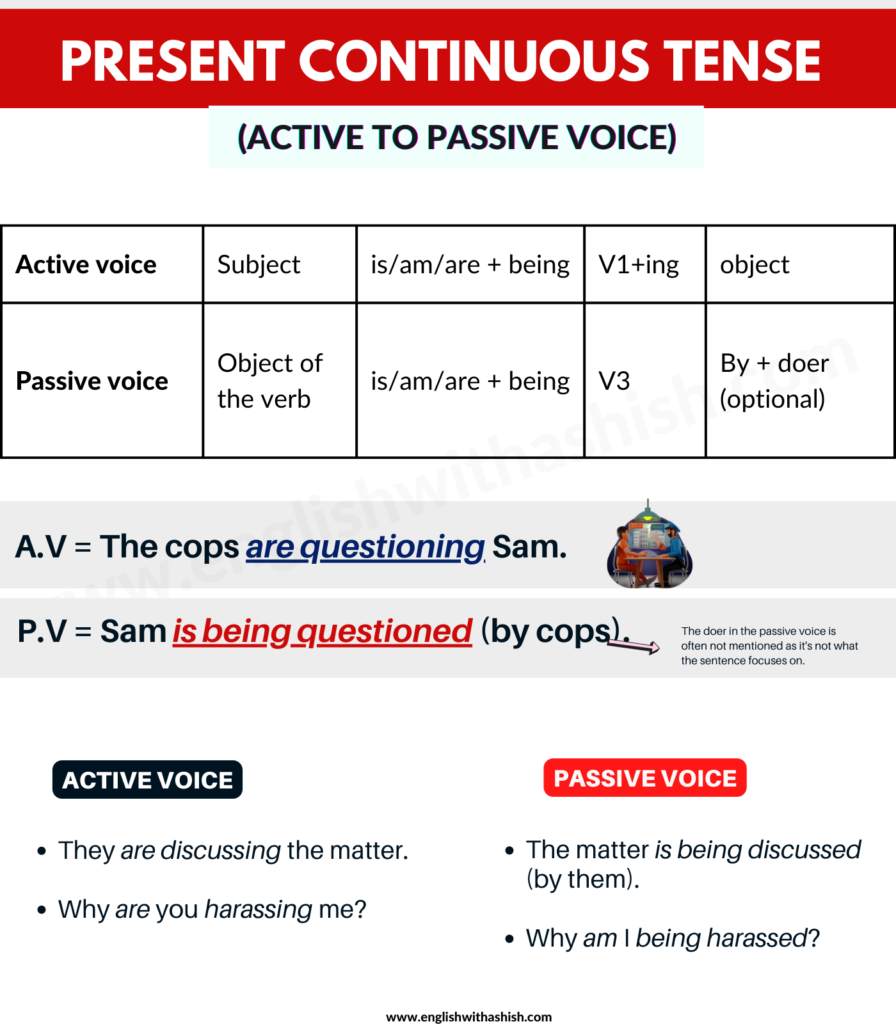
Examples:
- Active voice: Ashish is teaching English at this university.
- Passive voice: English is being taught by Ashish at this university.
- Active voice: They are making a movie about me.
- Passive voice: A movie about me is being made (by them).
- Active voice: Robots are serving food here.
- Passive voice: Food is being served by robots here.
- Active voice: They are taking interviews for different posts.
- Passive voice: Interviews for different posts are being taken (by them).
- Active voice: The police are interrogating him right now.
- Passive voice: He is being interrogated (by the police) right now.
- Active voice: Everybody is watching the final match.
- Passive voice: The final match is being watched by everyone.
- Active voice: Who is helping you with your project?
- Passive voice: Whom are you being helped by in this project?
- Active voice: Ron is not training the kids.
- Passive voice: The kids are not being trained (by Ron).
- Active voice: Are they playing cricket right now?
- Passive voice: Is cricket being played by them right now?
- Active voice: Why is he not helping us?
- Passive voice: Why are we not being helped by him?
NOTE: the helping verb (is/am/are) can be different in the active and passive voice of a sentence. The active voice (verb) follows the doer of the action, and the passive voice (verb) follows the receiver of the action. Also, the part within the parenthesis (brackets) is optional and is often not added to a sentence in the passive voice.
In the passive voice, the doer of the action, generally, is not mentioned as the focus is on the receiver of the action. It happens as the subject is either less important, understood, or unnecessary to mention.
Examples:
- His interview is being taken.
- The employees are being trained on emotional intelligence in the meeting room.
- The final match is being played at Wankhede Stadium.
- The next video is being recorded.
- Students are being punished for tricking the class teacher.
- Some people are being arrested on the road.
- Why am I being punished for a mistake I didn’t even make?
Note that in the above examples, we haven’t added the doer of the action as it is not what we are focusing on.
Change the active voice of the Present continuous tense into the passive voice!
Sentences in the active voice:
1. She is cooking food.
2. My parents are making budget plans.
3. The school is organizing a picnic.
4. Everyone is praising your work.
5. How are they doing it?
6. I am not doing anything these days.
7. Whom are you dating now?
8. Is he not doing anything?
9. Where are you giving classes?
10. Jon is discussing something important.
Answers:
1. Food is being cooked (by her).
2. Budget plans are being made (by my parents).
3. A picnic is being organized (by the school).
4. Your work is being praised (by everyone).
5. How is it being done (by them)?
6. Nothing is being done these days (by me).
7. Who is being dated (by you now)?
8. Is nothing being done (by him)?
9. Where are classes being given by you?
10. Something important is being discussed (by Jon).
Use of IS/AM/ARE
| IS | he, she, it & singular noun names (Jon, Roxy, mother, doctor, chair, etc.) |
| AM | I (first-person pronoun) |
| ARE | you, we, they & plural noun names (people, friends, parents, doctors, chairs, etc.) |
FAQs
What is an example of active passive present continuous?
Active: She is solving the question.
Passive: The question is being solved (by her).
Active: The management is hiring some IT professionals.
Passive: Some IT professionals are being hired (by the management).
Active: Why are they targeting me?
Passive: Why am I being targeted (by them)?
What is the passive voice of present continuous?
Here is how a sentence is changed from the active voice into the passive voice of the Present Continuous tense:
Active voice: Subject (doer) + is/am/are + V1+ing + object (receiver of the action)
Passive voice: Object (receiver) + is/am/are + being + V3 + ( by + doer)
Have a question or need deeper clarity? Drop it in the comments — I personally answer your questions/doubts.
If you found this lesson valuable, share it with peers or learners who will benefit. Let’s raise the standard of how we learn English — together.
Looking for personalised coaching to elevate your English, communication, and life skills?
I offer 1-on-1 mentorship that integrates advanced English fluency with emotional intelligence, confidence building, and personality development — designed to help you grow not just as a speaker, but as a powerful individual.
Reach out at [email protected] to get started.
On YouTube and Instagram, we break down real conversations, dive into pop culture, share quick grammar hacks, and do the things your textbook never could.
Follow now — and start learning smarter.

Thanks for help sir.
Happy to help, Dayana!
It is useful
Glad you found it useful.
Glad you liked it, Sirika!
Hii
Hi
Hi!
Hello
Hi Jannat,
How may I help you?
Convert in to passive voice the below sentence
1):
Open the Door.
Let the door be opened.
I am vry impressive your sentence.
But you are keeping on make sentence help to me thanks
Thank you for the kind words, Sajid.
Hi sir, can you please help me in making passive of this sentence
“He is not coming to school”
Please please help me with this thanks a lot!
It can’t be changed into the passive voice. The sentence does not have a direct object.
Sir ur comments are helpful and solutions too
Glad you find them helpful! Keep learning and stay connected.
Hello
Hello!
hi Ashish
Hello, Ajmal.
Lol
Hahahaha
10q it’it’s good mr
I am grammar teacher as well and for preparing the lectures i try to listen n read different online tutors to get fresh ideas . i really appreciate you Ashish making things easy for the learners and also for the teachers .
The way you defined the present continues tense it touched my heart.
Comments like this just makes us work harder. Glad you find the posts valuable. Keep learning and stay connected, Rashid!