This lesson helps us understand how to use few, a few, and the few in a sentence. We also understand how these expressions are different from one another.
‘A FEW’
The phrase ‘a few’ is a quantifier that can function as both an adjective and a pronoun. It means ‘not many’. When a speaker uses it, they emphasize a small number of something: people or things (plural noun). Though it refers to a small number, it is often enough for the context where it is used.
It means more than one but not many.
Examples:
- I have a few unused dresses in the wardrobe. You can take one if you want to.
- The company needs a few people to handle its social handles.
- Hanna would take a few minutes to explain the new project.
- We are going to stay in Mumbai for a few days.
- Get me a few things if you are going to the supermarket.
- I will be back in a few days.
Note that though it refers to a small number, it is used positively in a sentence.
‘FEW’
The word ‘few‘ means ‘a small number of something that is considered insignificant or not enough in the context where it is used’. It is used when the quantity the speaker refers to is not enough according to the speaker. When you refer to a quantity using the word ‘few’, you mean it is as good as nothing.
Examples:
- I have nowhere to go. I know few people in the city.
- We now have few days to pay the rent.
- We can’t make anything with few food items we have in the fridge.
- They had few moments in the game. We dominated them completely.
- Few cities in India have the nightlife of Bangalore.
THE FEW
The phrase ‘the few’ is used to refer to a specific quantity of something that is small in number. The connotation it gives depends upon the speaker, meaning it can carry both a positive and negative meaning.
Examples:
- We can’t arrange the money within the few days that are left.
- I can give you the few vacant seats that I have in my class.
- We can’t turn this into a huge business with the few people you have given us.
- Would you like to check out the few suits I have?
- Can you bring me the few water bottles you have in the backseat of your car?
FEW vs A FEW vs THE FEW
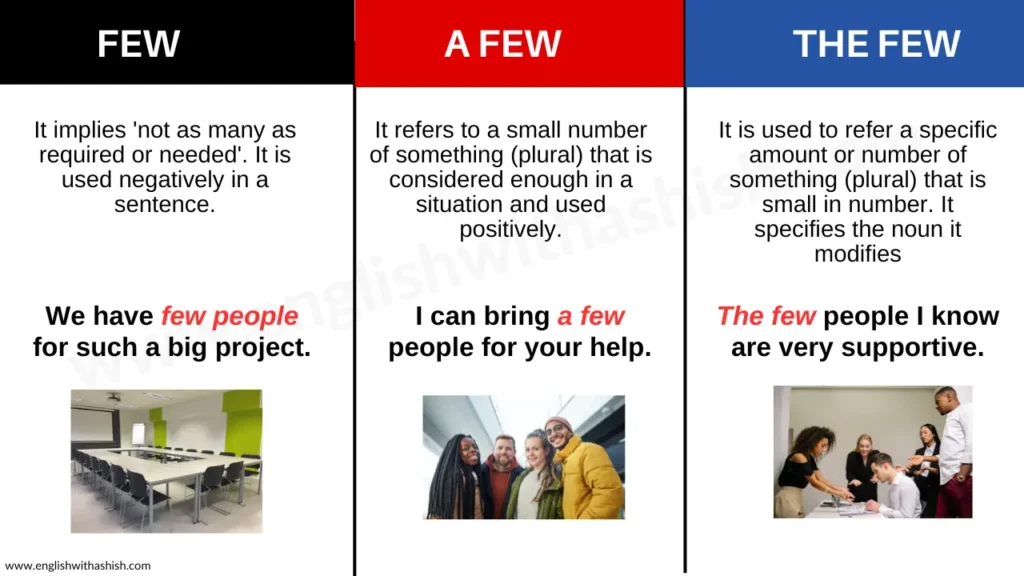
| Quantifiers | Meaning | Examples |
| FEW | The expression ‘few’ is used to refer to a small number of people or things that the speaker is not optimistic about. It carries a negative connotation. | 1. We can’t do anything with few guys on the team. 2. There are very few things in the world that can make me misbehave with my parents. |
| A FEW | It is used to refer to a small number of people, things, or any plural noun. The quantity, though small, is used positively in a context and is considered enough. | 1. I need a few slices of cheese from the fridge. 2. Tom will be here in a few hours. |
| THE FEW | The expression ‘the few’ is used to refer to a small quantity of people or things that the speaker makes specific. | 1. You failed at the few opportunities you were provided. 2. I still have the few pictures my mother left me. |
I can help you arrange the money. I know a few rich people in the city.
In this example, the speaker uses ‘a few’ to modify the noun ‘people’ and refers to a number that is small but enough for the situation. Notice that the speaker uses it positively in the sentence.
I don’t know how I can arrange the money in such a short time. I know few people in the city.
In this example, the speaker uses ‘few’ to refer to a number that is small to an extent where it does not help the situation. The quantity it refers to is obviously not enough, the speaker uses it negatively in the sentence as a result.
With using ‘few’, the speaker lets us know that they don’t know enough people to be able to arrange the money in a short time.
How many is a few?
The phrase ‘a few’ refers to a small number of people/things. What’s small can not be determined without knowing the context where it is used. It could be 4 in a situation and 14 in a different one. But one thing that’s definite about it is that the quantity it refers to is always more than 2.
Let’s study this with examples.
- Jon owns a few cars.
People often own a car or two. So, a few could be 3 or 4 or 5 here. Imagining a bigger number in this context would be misreading the situation. If the actual number is bigger than this, we should use ‘some/several’ instead of ‘a few’.
- Fifty thousand people were on their feet, rooting for the team. A few of them had the national flag painted on their faces.
In this context where ‘a few’ is chosen out of a population of 50000 people, it could refer to 20 people or even 30 people.
So, the number of people/things it refers to is decided by the situation you are dealing with. As already stated, it definitely refers to a number more than 2.
Important points
A) ‘Few’ carries a negative meaning. It implies ‘not a significant amount of people or things, or a plural noun or not enough’.
B) All the expressions—few and a few—might refer to the same number. What makes the difference is how the speaker feels about it in a given situation. 2 people with you on a road trip might be enough for you, but the same number of people at a party might not excite you.
C) Some and a few can be used interchangeably when you refer to a small number.
D) We have ‘the few’ in the expression ‘one of + noun phrase’.
- This is one of the few suits I wear to parties.
- She is one of the few teachers who care about us.
FAQs
What is the difference between few and a few and the few?
All the expressions—few, a few, and the few, refer to a small number of people or things. The difference is that ‘a few‘ is used positively, ‘few‘ is used negatively, and ‘the few‘ is used to a small number of people or things. Examples: 1. We have a few snacks for you. 2. Few biscuits that are in the fridge won’t satisfy your hunger. 3. The few workers that came to talk to you about their salaries have been fired.
Where do we use the few?
We use the expression ‘the few’ to refer to a small number of specific people or things. Examples:
1. Pass me the few files I have on my desk.
2. She took the few glasses I had in my closet.
3. You are one of the few people who can do this.
What is the difference between few and a few?
Both few and a few refer to a small number of something (plural noun), but the difference between them is that ‘few’ is used when the number is considered insignificant or not enough by the speaker, and ‘a few’ is used positively in a sentence.
1. I have a few ideas in mind for you.
2. I don’t think we can crack the deal with few people on the team.
When to use a few?
We use ‘a few’ to refer to a small number of people or things (plural noun) that is considered enough. It can be used as an adjective or a pronoun.
Ex-1. I have a few books you should read. (adjective)
Ex-2. Most people who came to the party left before the host came, but a few were still there till the end. (pronoun)
Is 2 or 3 a few?
A few is believed to mean at least three in most dictionaries. The actual number of people/things it refers to in a number can’t be predeclared.
Now, we know how to use few, a few, and the few in a sentence, and how they are different from one another. Feel free to share your question, doubt, or feedback in the comment section, and also, share the post with the people that need it.
For one-on-one classes, contact me at [email protected].
