This lesson helps us understand what countable and uncountable nouns are, how to identify them, and learn what the difference between countable and uncountable nouns are.
What are countable nouns in English?
Countable nouns are words that refer to people, things, places, or other noun names that we can count. Though most countable nouns have a physical existence, they don’t have to have a physical nature to be able to fall into this category. They can be concrete or abstract in quality.
Note that we can use numbers of quantifiers before countable nouns only because they are countable, meaning they can be in both singular and plural forms.
| Singular countable nouns | Plural countable nouns |
| Boy | Boys |
| Girl | Girls |
| Table | Tables |
| Pen | Pens |
| Copy | Copies |
| School | Schools |
| Building | Buildings |
| Bottle | Bottles |
| Failure | Failures |
| Goal | Goals |
NOTE: Some countable nouns are concrete in nature, meaning they have a physical existence, and some countable nouns are abstract/nonphysical in nature.
Countable nouns that are concrete in nature
| Types of nouns | Singular countable nouns | Plural countable nouns |
| Proper noun | Ashish, India, Delhi, Google, Asia, March, Diwali, English, Audi A8… | Ashishs, Indias, Delhis… ❌ It does not have a plural form as it refers to someone/something specific considered one in number. |
| Common noun | boy, girl, friend, country, city, dog, month, festival, school, car… | boys, girls, friends, countries, cities, dogs, months, festivals, schools, cars… |
| Collective noun | class, army, jury, audience, family, team, group… | classes, armies, juries, audiences, families, teams, groups… |
| Material noun | milk, cotton, wood, iron, gold, rice, water, tea, silver… | milks, cottons, woods, golds, rices… ❌ Material nouns are uncountable in nature as they refer to the material something (an object) is made from. It can be weighed not counted. |
Countable nouns that are abstract in nature
An abstract noun is a word that refers to something that does not have a physical existence. It refers to an idea, concept, subject, emotion, state, etc. Note that some abstract nouns are countable and some are not. Let’s study some examples of countable and uncountable abstract nouns.
| Type | Singular countable nouns | Plural countable nouns | Singular uncountable nouns |
| Abstract nouns | ability advantage loss profit win dream exam wish idea thought opportunity career sarcrifice | abilities advantages losses profits wins dreams exams wishes ideas thoughts opportunities careers sacrifices | honesty love hate freedom liberty pain joy management satisfaction harassment maturity anger knowledge |
Some abstract nouns (shown in the last column) are uncountable in nature and considered singular. They simply don’t have a plural form.
Examples (countable):
- You were given many opportunities to prove your caliber.
- She is taking advantage of you.
- I had a bad dream last night.
- What are your thoughts on this new system, Ashish?
- Everyone likes compliments.
- Your losses never define you. It’s how you act in them.
Examples (uncountable):
- Your determination and courage help you in winning any battle.
- What most people crave in life is love.
- His growth has been exceptional.
- Ashish said, “I don’t feel pain.”
- He needs to learn how to control his anger.
- Your ego can do worse for you than you can imagine.
- All the guys on the team have shown immense maturity in their actions.
What are uncountable nouns in English?
Uncountable nouns are words that refer to something that can’t be counted. These are concepts, emotions, subjects, ideas, qualities, materials, etc. Since we can’t count these nouns, they don’t have a plural form and are considered singular.
| Uncountable nouns categories | Examples |
| Emotions | joy, happiness, sadness, anger, love, disgust, admiration, sadness, anxiety, ecstasy… |
| Concepts/Ideas | polygamy, democracy, marriage, divorce, meditation, individualism, politics… |
| Subjects | English, Hindi, Economics, Accountancy, Marketing… |
| Qualities | calmness, honesty, Bravery, maturity, positivity, responsibility… |
| Materials | rice, water, milk, sugar, oil, wood, iron, gold, cotton… |
| Stage | childhood, infancy, adulthood… |
Examples:
- Democracy gives everyone the right and liberty to voice their opinions.
- Ashish doesn’t like water in his tea.
- I find joy and happiness in small things.
- Some of these guys are going to prison for doing corruption.
- Why is there water on the floor?
- I appreciate your honesty.
- Meditation can change your life.
- She was awarded for her loyalty.
- You don’t seem to have a lot of passion about it.
- The man has so much wisdom to pass on.
- Control your mind to control the outcome of your life.
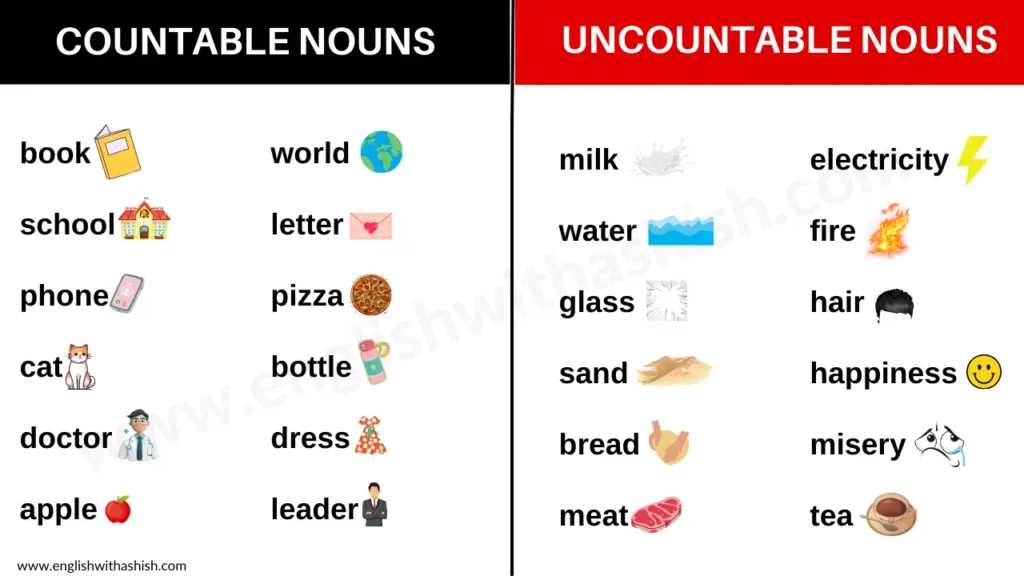
Countable and uncountable nouns (physical and nonphysical)
The infographic below shows some countable and uncountable nouns that are in physical and nonphysical (abstract) forms.
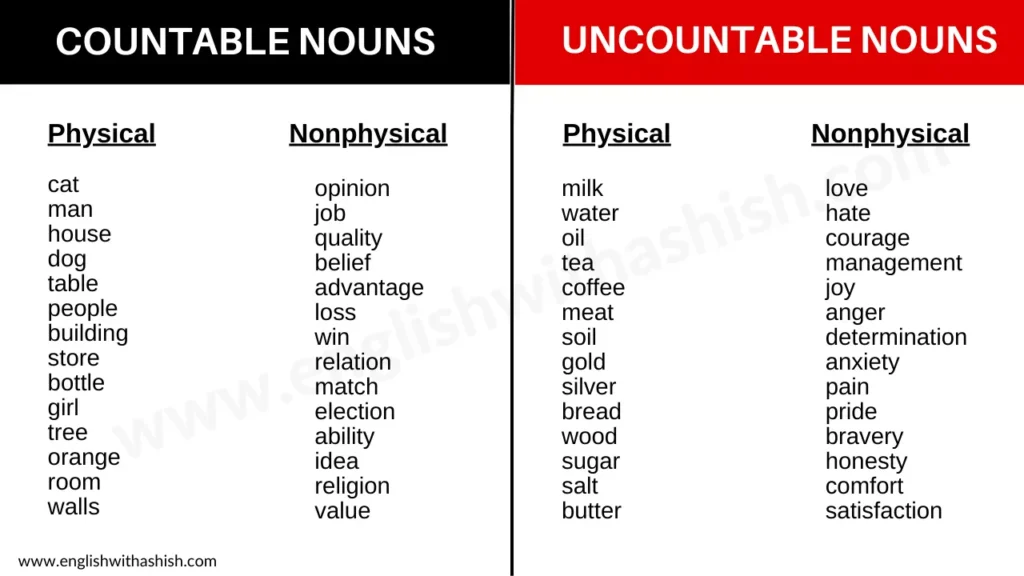
More countable and uncountable nouns (physical and nonphysical)
Countable nouns (physical)
- couch
- books
- people
- bulb
- snake
- mango
- leader
- phone
- book
- ring
- snakes
- Forest
- river
- mountain
- plant
- tree
Countable nouns (nonphysical/abstract)
- record
- election
- promotion
- demotion
- dream
- gossip
- rule
- ability
- fact
- memory
- need
- religion
Uncountable nouns (physical)
- tea
- coffee
- soil
- dirt
- plastic
- iron
- air
- dust
- food
- petrol
- furniture
- snow
- smoke
Uncountable nouns (nonphysical/abstract)
- fun
- freedom
- fear
- aggression
- assistance
- chaos
- comfort
- confidence
- confusion
- education
- enmity
- entertainment
- enjoyment
- fame
- faith
- fatherhood
- brotherhood
- management
- patience
- poverty
- publicity
- tolerance
- trust
Practice set!
Choose if the underlined words are countable or uncountable nouns in the following sentences:
- Don’t act like my father!
- The government has only made false promises and done corruption.
- There is no problem in the world that can’t be solved with love.
- Alan is in need of some blood.
- The growth of this company has been exceptional.
- Everyone needs a little admiration.
- All of the boxes got damaged in the accident.
- You are not a stranger to me.
- I left the job for my dignity.
- The city has so much to offer.
FAQs
How can I teach countable and uncountable nouns?
The first thing to do while trying to find out whether a noun is countable or uncountable is to see if refers to an object (something physical or nonphysical). Once that is identified, see if you can count it.
What is an example of a countable and uncountable noun in a sentence?
“My parents have filled this place with love and respect.” There are 4 nouns in the sentence, two countable and two uncountable.
Countable nouns: parents (plural), place (singular)
Uncountable nouns: love, respect
Is milk countable or uncountable?
Milk is an uncountable noun. It is a name of a liquid, which we can’t count. Mass nouns can’t be counted; they can be weighed.
Is money an uncountable noun?
Money is an uncountable noun. We can’t count money; it is a general idea. It does not have a physical existence. What we can count are coins and notes.
Why is bread uncountable?
The noun ‘bread’ refers to a material a lot of objects (like pizzas, burgers, sandwiches, pancakes, etc.) are made of. We can’t count the material that is bread. We, though, can count objects made from it, like slices of bread, burgers, chapatis, pizzas, etc.
Is oil a countable noun?
No, oil is an uncountable noun. We can’t count oil as it is a material in a liquid form. We can weigh it or count the bottles, barrels, cans, glasses, and bowls it can be put in.
Is sugar a countable noun?
Sugar is a mass noun. It is a material that is used in many objects.
What are countable and uncountable nouns in questions?
Here are some examples of countable and uncountable nouns in questions:
1. Are you interested in a job? (countable)
2. When is he giving my laptop back? (countable)
3. Should the company pay for your traveling expenses? (countable)
4. Do you want some money? (uncountable)
5. Why do children love drinking milk? (uncountable)
6. Why do I lack discipline? (uncountable)
Now, we know what countable and uncountable nouns are and everything about them. Feel free to share your question, doubt, or feedback in the comment section, and also, share the post with the people that need it.
For one-on-one classes, contact me at [email protected].
