This post helps us understand what an adverbial phrase of reason is, what it does in a sentence, and how we can identify it.
What is an adverbial phrase of reason in English?
An adverbial phrase of reason, also known as an adverbial phrase of purpose, is a phrase that modifies a verb and indicates the reason for the action. It is usually a prepositional phrase, infinitive phrase, or participle phrase that functions as an adverbial of reason/purpose.
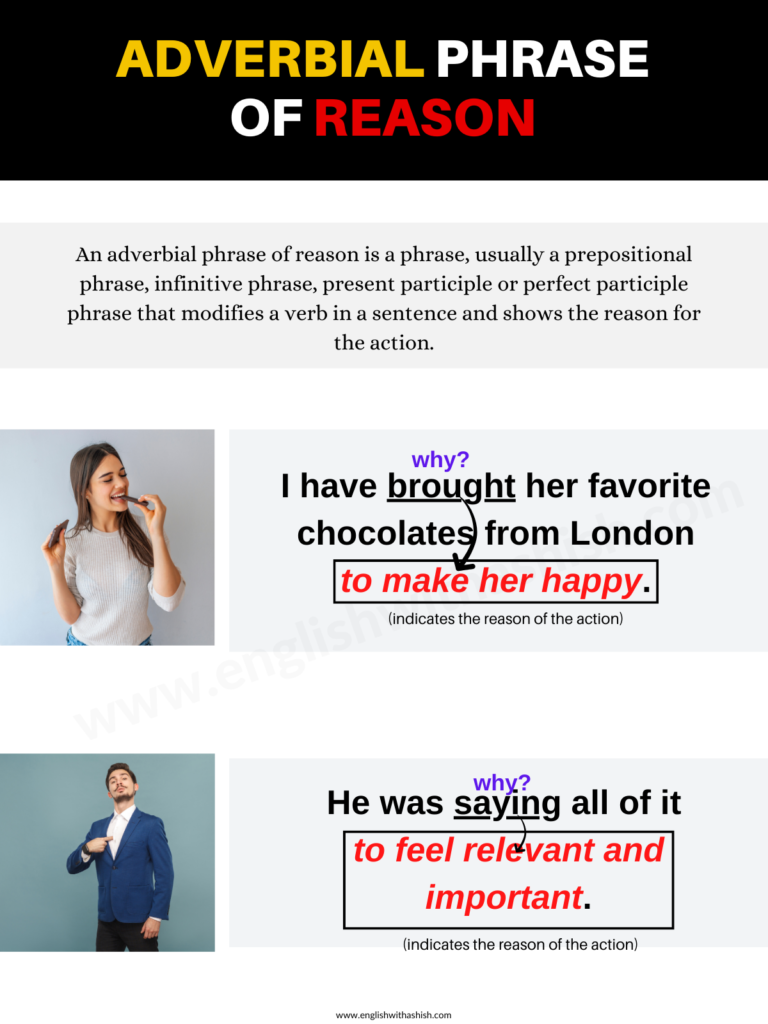
We lost the match due to being reckless.
The prepositional phrase ‘due to being reckless’ tells us why we lost the match. It shows the reason for the action and works as an adverbial phrase of reason.
Wanting to have his family, Mukesh got married to a Pakistani girl.
In this example, the phrase ‘wanting to have his family’ modifies the verb and indicates the reason for the action. It is a present participle phrase acting as an adverbial phrase of reason in the sentence.
Having been fired from the job, my brother got depressed and started drinking.
In this example, the perfect participle phrase ‘having been fired from the job’ works as an adverbial of reason by modifying the verbs of the main clause and showing the reason for the action.
Examples of adverbial phrases of reason:
- We have built this extra room because of your situation.
- Jon’s family moved to London in order to live a better life.
- I have come here to check on you.
- Hoping to get all the attention, I bought a really expensive suit for the party.
- The man does two jobs to earn more money.
- He was saying all of it to feel relevant and important.
- Having had a good relationship with Tarang, I agreed to let him use one of my flats.
- Having no cab available at that time, I decided to walk back home.
- No one wants to hang out with you because of your aggressive behavior.
How to identify an adverbial phrase of reason?
Identifying an adverbial of reason— a word, phrase, or clause— is actually quite simple. All we have to do is to ask the question ‘why’ to the verb. The answer to the question is the adverbial of reason.
Let’s put this trick to the test.
- Due to heavy rain, all of us took a day off.
Why did we take a day off? The part that answers this question is ‘due to heavy rain’—a prepositional phrase. It tells us why we took a day off. It was because/due to heavy rain that we took a day off.
Let’s take more examples to test it.
- Having been ill, Sneha did not show up at the party.
Why did Sneha not show up at the party? It was because of being ill that she decided not to go to the party. In this example, the present participle phrase works as a reason for the main verb and functions as an adverbial phrase of reason.
- I refused to drink at the party because of my aversion to drinking.
Why did the speaker not drink at the party? Is there any part that works as a reason why it didn’t happen? The phrase ‘because of my aversion to drinking’ clearly is the reason for it.
I didn’t drink at the party because I had an aversion to drinking.
What functions as an adverbial phrase of reason?
The following are the phrases that can function as an adverbial phrase of reason:
- Prepositional phrase
- Infinitive phrase
- Participle phrase
Prepositional phrases
- The boss has agreed to give you another chance because of me.
- He got fired from work due to his slackness.
- We had to sell the house in order to pay off the loan.
The phrases italicized are prepositional phrases that provide a reason for the action in the sentence. Note that prepositional phrases start with prepositions because, due to, in and order to.
Infinitive phrases
- I will be flying to Sri Lanka to support the Indian cricket team.
- He quit the job to focus more on his family business.
- Allen will be calling you in the evening to invite you to his wedding.
Notice that the infinitive phrase, italicized, are giving the reasons for the happening or nonhappening of the action in the sentences.
Participle phrases
- Wanting to be paid more money, Jon went to the boss.
- Thinking of his struggling days, he started tearing up in front of us.
- Having been brutally injured in the accident, he took some days off from work.
- Having heard the news of his accident, we decided to take the day off and see him.
In the first two examples, the parts italicized are present participle phrases working as a reason for the action, and in the last two examples, it’s the perfect participle phrases that do the same job.
Adverbial phrase of reason to adverbial clause of reason
We have seen and understood what adverbial phrases of reason are and how they look. Now, let’s understand how we can change an adverbial phrase of phrase into an adverbial clause of reason.
This is essential to understand because some English learners find it difficult to form and understand adverbial phrases of reason. So, let’s learn how to understand and change them into adverb/adverbial clauses of reason.
Adverbial phrase: We lost the match due to/because of being reckless.
Adverbial clause: We lost the match because we were reckless.
Notice that we have changed the adverbial phrase into the adverbial clause by adding a subject and its verb to it.
Key Differences: Adverbial Phrase of Reason vs. Adverbial Clause of Reason
| Feature | Adverbial Phrase of Reason | Adverbial Clause of Reason |
|---|---|---|
| Structure | A group of words without a subject and verb | A group of words with a subject and verb |
| Function | Modifies the verb and gives the reason | Modifies the verb and gives the reason |
| Verb Presence | No complete verb | Contains a complete verb |
| Example | Due to illness, he left early. | He left early because he was ill. |
| Wordiness | More concise | Slightly longer |
| Common Starters | Because of, due to, in order to, wanting to… | Because, since, as, so that… |
| Usage in Formal Writing | Often preferred | Used more in casual or explanatory writing |
| Adverbial phrase sentences | Adverbial clause sentences |
| Having had a good relationship with Tarang, I agreed to let him use one of my flats. | I agreed to let Tarang use one of my flats because/as/since I had had a good relationship with him. |
| Wanting to be paid more money, Jon went to the boss. | Jon went to the boss because he wanted to get paid more money. |
| Allen will be calling you in the evening to invite you to his wedding. | Allen will be calling you in the evening because he wants to invite you to his wedding. |
| Having been brutally injured in the accident, he took some days off from work. | Because Max was brutally injured in the accident, he took some days off from work. |
Why Adverbial Phrases of Reason Matter
Here are a few very important reasons why you should care about adverbial phrases of reason:
- They add depth to your sentences by showing why something happens — making your writing more logical and purposeful.
- They help you avoid repetition by expressing complex ideas more smoothly.
- In formal writing (like essays or reports), they tighten your sentences and improve clarity.
- Mastering them builds confidence in your grammar skills and makes you sound more fluent and natural.
Handy Tips to Use Adverbial Phrases of Reason Correctly
Knowing what something is and how to use it is not enough for you to speak effectively and write precisely. You must also know when and when not to employ it.
Pro tips:
- Ask “Why?” to find the phrase — it should answer the reason for the verb.
- Use them before or after the main clause, depending on flow and emphasis.
- Watch out for wordiness — use phrases only when they add value.
- Be clear with participle phrases; avoid misplaced modifiers.
- Use infinitive phrases to show purpose and intention more naturally.
- In formal writing, avoid starting a sentence with “Because of…” too often — vary your structures.
Mistakes to avoid:
- ❌ Starting with a participle phrase that doesn’t clearly link to the subject (e.g., “Being tired, the homework was not done.”)
- ❌ Confusing “because” (clause) with “because of” (phrase)
- ❌ Using too many phrases that clutter your writing
- ❌ Forgetting to include a subject in clause versions
Fixing these mistakes helps your writing sound more natural and grammatically correct.
Conclusion
Whether you want to use an adverbial phrase of reason or adverbial clause is your decision or style of writing or speaking. You should go ahead with what feels more natural and comfortable to you.
However, using adverbial phrases makes sentences more precise using fewer words, and therefore, we should try to incorporate them in our writing and speaking.
FAQs
What is an adverbial phrase of reason?
An adverbial phrase of reason modifies a verb and states the reason for it. It tells us why the action takes place in form of a prepositional phrase, infinitive phrase, or participle phrase.
What are some examples of adverbial phrases of reason?
Here are some examples of adverbial phrases of reason:
1. The company is promoting you something because of your dedication and hard work.
2. The organizers cancelled the match due to security threats.
3. She is coming home to confront you.
4. Wanting to help the poor, Virat started an NGO.
What functions as an adverbial phrase of reason?
A prepositional phrase, infinitive phrase, and participle phrase can function as an adverbial phrase of reason.
What are 5 examples of adverbial phrases of reason?
Here are 5 clear examples:
1) Because of the heavy traffic, we missed the meeting.
2) Due to his carelessness, he lost the project.
3) To impress her classmates, Meera memorized the entire poem.
4) Wanting to be noticed, he kept interrupting the teacher.
5) Having been warned before, they avoided that shortcut.
What are the different types of adverbial phrases?
Adverbial phrases can be categorized by what they tell us:
1) Adverbial phrase of time – tells when
→ After the meeting, she went home.
2) Adverbial phrase of place – tells where
→ He hid under the table.
3) Adverbial phrase of manner – tells how
→ She danced with great energy.
4) Adverbial phrase of reason (or purpose) – tells why
→ He apologized to avoid conflict.
5) Adverbial phrase of condition – tells under what condition
→ Without your help, I can’t complete this.
What are the components of an adverbial phrase?
An adverbial phrase typically consists of:
1) A head word (main verb, participle, or preposition)
2) One or more modifiers or complements (nouns, objects, or verbals)
Depending on the type, it could be a:
1) Prepositional phrase → Because of his effort
2) Infinitive phrase → To win the prize
3) Participle phrase → Having studied hard
What is the definition of an adverbial phrase?
An adverbial phrase is a group of words that acts as a single adverb. It modifies a verb, adjective, or another adverb by adding extra information about time, place, manner, reason, or condition.
Examples:
1) In the morning, we went jogging. (time)
2) With great care, he handled the baby. (manner)
3)To make her proud, he studied hard. (reason)
Now, we know what an adverbial phrase of reason is and everything about it. Feel free to share your question, doubt, or feedback in the comment section, and also, share the post with the people that need it.
For one-on-one classes, contact me at [email protected].