Every sentence in the English language is either written in the active voice or the passive voice. We must be aware and capable of writing sentences in both voices.
This post helps you master how to write sentences in the Present indefinite tense passive voice and how to change sentences from active to passive voice in the Present Indefinite tense. Note that the Present Indefinite tense is also commonly known as the Simple Present tense.
Look at the following examples:
- My friends appreciate my work. (Active voice)
The subject = my friends
The verb = appreciates
The object of the verb = my work
- My work is appreciated by my friends. (Passive voice)
The subject = my work (the receiver of the action)
The verb phrase = is appreciated
The doer of the action (original subject) =my friends
Both sentences are in the Present Indefinite tense, but the voices these verbs are in are different. The verb in the first sentence (appreciate) is written in the active voice, and the second one (is appreciated) is in the passive voice. In the first sentence, the focus is on the doer of the action, meaning the focus is on the people who do the action (the subject), but in the second sentence, the focus is on the receiver of the action (the object); what is acted upon is more important than who does the action in the second sentence.
A sentence in the active voice focuses on the doer of the action (the person who does the action), and a sentence is written in the passive voice when the writer wants to focus on the receiver of the action. The doer of the action is not even mentioned most of the time in the passive voice as the focus is on the object. Here, what has been done is what’s important, not who has done it.
Active voice to Passive voice in the Present Indefinite Tense
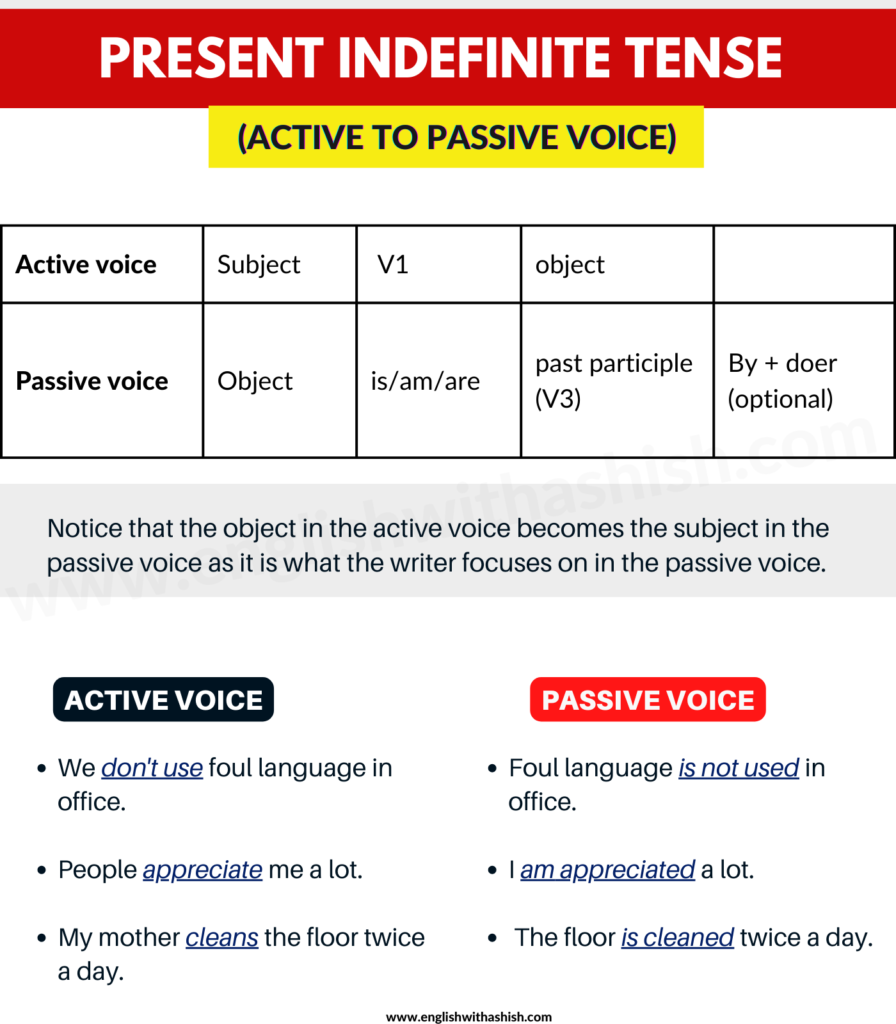
Study the following structures to understand how to write sentences in the active and passive voice of the Present Indefinite tense:
| Active voice | Subject (the doer of the action) | a base form of a verb (V1) | object | any other part (optional) |
| Passive voice | Subject (receiver of the action) | is/am/are | past participle (V3) | By + the doer of the action (optional) |
Notice that the object in the active voice becomes the subject in the passive voice as it is what the writer focuses on in the passive voice. Who has done the action is not important in the passive voice, it is the object that the focus is placed on.
Examples:
- Active: People speak English around the world.
- Passive: English is spoken around the world (by people).
NOTE: The part within the parenthesis (brackets) is optional and is often not added to a sentence in the passive voice.
- Active: No one has ever invited me to an Indian wedding.
- Passive: I have never been invited to an Indian wedding (by anyone).
- Active: Does he call you baby?
- Passive: Are you called baby by him?
- Active: The MMA community hates Colby Covington.
- Passive: Colby Covington is hated by the MMA community.
- Active: They close the bar every day at 9 pm.
- Passive: The bar is closed every day at 9 am.
- Active: Rahul cleans the dishes every day.
- Passive: Dishes are cleaned every day.
It is not important who cleans the dishes; the important point is that the action is done upon them every day.
- Active: Jon teaches wrestling at my school.
- Passive: Wrestling is taught by Jon at my school.
- Active: Some people don’t love me.
- Passive: I am not loved by some people.
- Active: Who calls you every night?
- Passive: Who are you called by every night?
NOTE: In the passive voice, the doer of the action (generally in most cases) is not mentioned in the sentence as it is not what the focus is on; a sentence in the passive voice focuses on the receiver of the action (someone/something that the action is done upon). But you can always add the doer of the action if you want to or if it’s required.
More examples of the Present indefinite tense passive voice
- These questions are never asked in interviews.
- The best biryani is made in Hyderabad.
- Everyone is strictly checked at the P.M. residency.
- These plants are watered every day.
- He is followed by people around the world.
- These students are beaten every day.
- We have never been appreciated for our work.
- Yesterday, I was called to speak to some orphans.
- This book has been written in 15 languages.
Try changing the following sentences in the active voice into the passive voice!
Sentences in the active voice:
1. They don’t hate me.
2. Most people like junk food.
3. They promote their brands all over the country.
4. Everyone wants you.
5. Interviewers ask anything these days.
6. Nobody helps them.
7. Does she call you every day?
8. Doctors save us.
9. She doesn’t treat you well.
10. My father cooks food sometimes.
Answers:
1. I am not hated by them.
2. Junk food is liked by most people.
3. Their brands are promoted all over the country by them.
4. You are wanted by everyone.
5. Anything is asked these days by interviewers.
6. They are not helped by anyone.
7. Are you called every day by her?
8. We are saved by doctors.
9. You are not treated well by her.
10. Food is cooked by my father sometimes.
FAQs
What is the example of active to passive voice in present tense?
Active: They prepare food in the basement.
Passive: The food is prepared in the basement (by them).
Active: No one eats meat here.
Passive: Meat is not eaten here (by anyone).
How do you change active to passive in Present indefinite tense?
A sentence in the active voice of the Present Indefinite tense is changed into the passive voice by using the following structure: Object (the receiver of the action) + is/am/are + past participle (V3) + by the doer (optional).
The object in the active voice is made the subject in the passive voice as it is what the speaker focuses on in the passive voice.
Have a question or need deeper clarity? Drop it in the comments — I personally answer your questions/doubts.
If you found this lesson valuable, share it with peers or learners who will benefit. Let’s raise the standard of how we learn English — together.
Looking for personalised coaching to elevate your English, communication, and life skills?
I offer 1-on-1 mentorship that integrates advanced English fluency with emotional intelligence, confidence building, and personality development — designed to help you grow not just as a speaker, but as a powerful individual.
Reach out at [email protected] to get started.
On YouTube and Instagram, we break down real conversations, dive into pop culture, share quick grammar hacks, and do the things your textbook never could.
Follow now — and start learning smarter.

Thanks sir Aaj mera test tha school me kuch acche se padaya nhi gya tha aapke diye hue structure se rewise ho gya thanks ✌️
You are welcome, Sanu! Happy to know that!
This is awesome sir
Glad you liked it, Dayana! Keep learning!
Sir have AWS by this
Thankyou sir
You are welcome, Shaza!
Thank you so much sir kal mera test he hope I will do good
Best of luck, Fatima.
This really amazing
Thank you.
Aaj Mera test hai or mujhay is se samajh a gy
That’s great. Glad the post could help.
Yes sir
Hi
This post is very useful for me
Thanks a Lots of.
Glad you liked it, Shekhar. Keep learning!
ma sha allah keep it up…
Thank you!
Thank you Soo much sir ap k structure na bacha Lea warna suba school m mot paki thi
Haha! I am glad I could help, Ayesha.
Sir kuch words ka object bech me kyu h or patta kaise lage ga ke object bech me h ya last me
Beech me se aap kya kehna chah rahe hai? The object of the verb comes right after the verb, and so do the other objects (they come right after their heads).
SIR GREAT! YOUR POST HELP ME VERY MUCH. YOUR THANKS A LOT.
I am glad to know that I could help. Keep learning and stay connected, Ali.
Sir you are th best for why don’t you teach in a institute whatever you are the best
Thank you for the kind words, Tanmay.
Also make a sentence from passive voice to active voice ….
Anyhow amazing work!
Thank you, Tehreem.