This lesson helps us understand what an adverbial phrase of time is, what can function as an adverbial of time, and how to identify it in a sentence.
Table of Contents
What is an adverbial phrase of time?
An adverbial phrase of time is a phrase that modifies a verb in terms of time, meaning it indicates the time of the action, the time duration of the action, or its frequency.
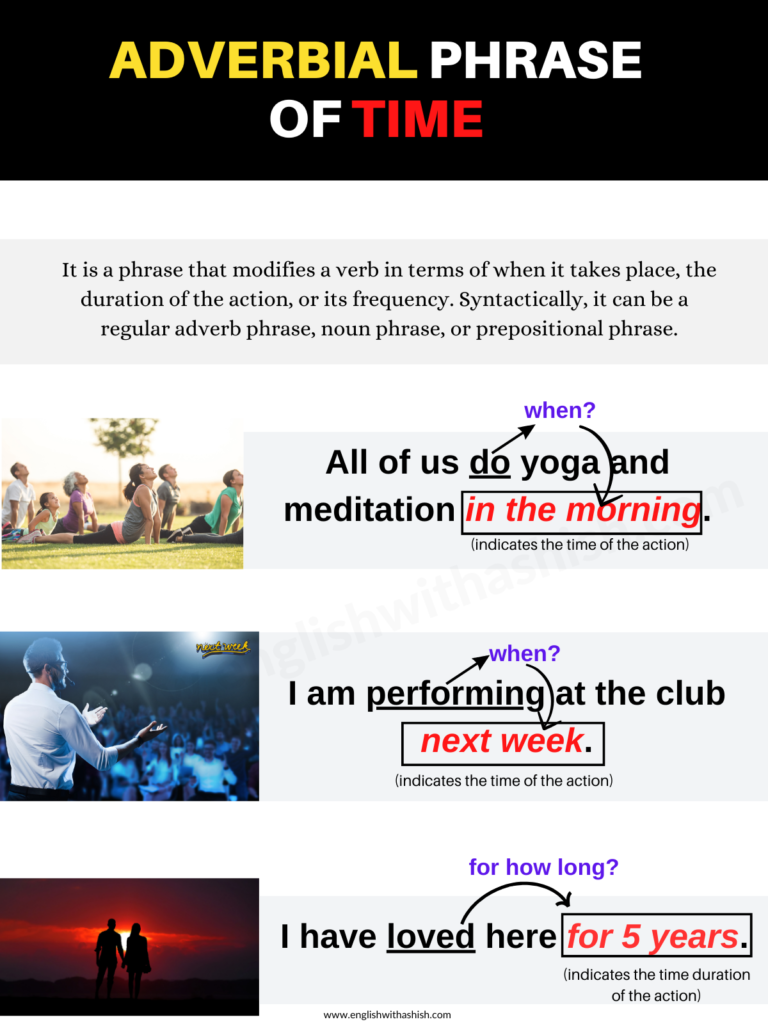
I saw your brother with someone in the morning.
The prepositional phrase ‘in the morning’ modifies the verb ‘saw’ in the sentence and indicates the time of the action. It tells us when the subject performed the action—saw someone with someone.
Since it works as an adverbial of time, and it’s a phrase, we will call it an adverbial phrase of time.
Ashish has been teaching Ashish for half a decade.
In this example, the phrase ‘for half a decade‘ indicates how long the action of teaching has been taking place. It modifies the verb by talking about its time duration.
Someone jumped off this bridge two days ago.
In this example, the adverb phrase ‘two days ago’ refers to the time when the action—jumping off the bridge—took place. Since it’s a phrase and works as an adverb of time, we are calling it an adverb/adverbial phrase of time.
Adverbials or adverbial phrases is a bigger term. It includes all regular adverbs and adverb phrases and also all the other phrases that function as an adverb in a sentence.
Examples of an adverbial phrase of time:
- Last night, all of us went to a bar to celebrate Aman’s birthday.
- We will call you after the meeting.
- The voting line ends in an hour.
- I don’t like to go out in the wee hours.
- Most of the guys on the team were sleeping during the session.
- Allen came to my place at midnight.
- Our school is taking us to a museum next week.
- We go out to hilly areas in the summer.
- Why have you come to talk about this at dinnertime?
- Make sure you bring the kids home by 9 p.m.
- We have lived here in this society since 1990.
Functions of an adverbial phrase of time
An adverbial phrase of time modifies a verb in the following ways:
- To indicate when the action happens/happened
- To indicate for how long the action happens/happened
- To indicate the frequency (how often) of the action
The time of the action
- We opened this office in 2010.
- You were behaving a little oddly last night.
- These guys don’t eat anything in the morning.
- We will help you with your assignment after the class.
In these examples, the phrases italicized modify the main verb of the sentence and refer to the time of the action. Since they are modifying the verb in terms of time, we are calling them adverbial phrases of time. Ask ‘when’ to a verb to find out its adverbial or adverbial phrase of time.
The time duration of the action
- We have been teaching here for 10 years.
- Tina and I have been in love since 2013.
- The boys have been practicing all day long.
- The food will be provided to everyone free of cost from June 1 to June 10.
- You waited till Friday to get a reply from the department.
In these examples, the adverbial phrases refer to the time duration of the action. Ask ‘how long’ or ‘since when’ to a verb to find out its adverbial or adverbial phrase of time (duration).
The frequency of the action
- My mother goes to a temple near my house every Sunday.
- I almost always come back home by 9 p.m.
- Ashish mediates twice a day.
- Allen comes to my place to see me thrice a month.
- We go out and play cricket every Sunday.
The phrases italicized are adverbial phrases of time. These phrases modify the verb in terms of its frequency—how frequently it takes place. Asking ‘how frequently’ to a verb gets us its adverbial of time (frequency).
What can be an adverbial phrase of time?
The following are the phrases that can function as an adverbial phrase of time:
- Regular adverb phrase
- Prepositional phrase
- Noun phrase
Regular adverb phrases
- My friend Chow bought a huge house a week ago.
- We are opening the bar very soon.
Both the phrases—a week ago and very soon—are regular adverb phrases that modify the verbs ‘bought’ and ‘opening’ in their respective sentences.
Adverb phrase 1 = a week ago
Head adverb = ago
Adverb modifier = a week
Adverb phrase 2 = very soon
Head adverb = soon
Adverb modifier = very
Prepositional phrases
- Meet me in my cabin after the session.
- We will surprise him with all the gifts at midnight.
The adverbial phrase of time in these sentences is a prepositional phrase. In the first example, the prepositional phrase—after the session—modifies the verb ‘meet‘, and the prepositional phrase in the second example—at midnight—modifies the verb ‘surprise‘. Both phrases modify the verbs in terms of time.
Noun phrases
- Adam, one of my good friends, left for China last year.
- We are going out next week.
The phrases—last year and next week—are syntactically noun phrases. They have a headword—year and week—and their modifiers—last and next. Despite being a noun phrase syntactically, they function as an adverb and modify a verb in the sentence. They indicate the time of the action in the sentences and function as an adverbial phrase of time.
More examples of adverbial phrases of time
- I no longer have the right to make decisions for the team.
- Monu brought the money I needed in no time.
- I see him with his friends all the time.
- We should go out on a tour once a year.
- Joe and I have known each other for a long time.
- The Guptas left for Canada two days ago.
- I have not seen my best friend Mangest in 6 months.
- No one touched their phone during the class.
- Meet me at platform number 6 before the departure of the train.
Practice set 1
Rewrite the sentences changing using an adverbial phrase of time.
- She finished her homework before the guests arrived.
- After he woke up, he went for a run.
- He got a call while he was having lunch.
- Since the show started, the kids have been quiet.
- We went straight home after the movie ended.
The answers to the questions are provided at the end of the article.
Why Understanding Adverbial Phrases of Time Matters
Many learners memorize grammar but don’t understand why it matters. This builds a practical connection — and answers intent. If you’re trying to speak like a native or ace an English exam — mastering adverbial phrases of time is a game changer.
Why is this important?
✅ Helps you communicate clearly when talking about time.
✅ Makes your writing more precise and expressive.
✅ Allows you to speak and write fluently without repeating time words.
✅ Boosts your confidence in both casual conversations and exams.
✅ It’s heavily tested in exams like IELTS, TOEFL, SSC, and board-level English.
Tips to Use Adverbial Phrases of Time Correctly
Tips to use adverbial time phrases better:
✅ Ask “When?” or “How long?” — The answer is usually your adverbial phrase.
✅ Place short phrases at the beginning for emphasis. (“Last year, I moved to Delhi.”)
✅ Avoid stacking too many time expressions in one sentence.
✅ Learn common collocations (e.g., by midnight, after dinner, every Sunday).
✅ Don’t confuse adverbs with adverbial phrases — e.g., now vs right now.
Common Mistakes to Avoid with Adverbial Phrases of Time
Mistakes English learners make:
❌ Using too many time references in one sentence
→ “Last night at 10 p.m. after dinner we went out.” (Overloaded)
✅ “After dinner, we went out at 10 p.m.”
❌ Wrong placement of the phrase, causing confusion
→ “We will at 7 p.m. meet you.”
✅ “We will meet you at 7 p.m.”
❌ Mixing frequency and duration incorrectly
→ “He goes there for every day.”
✅ “He goes there every day.”
❌ Using incomplete phrases that confuse the reader
→ “She left since 3 hours.”
Practice set 2
Identify the adverbial phrase of time in the following sentences:
- She always drinks coffee before going to work.
- They get the payment at the beginning of the month.
- He loses his mind once in a while.
- I bumped my car into a tree the day before yesterday.
- I will definitely return your money next month.
- You changed your mind pretty soon.
- While having dinner, someone came to my house and started firing at us.
- The man won’t get up until midnight.
- No one moved from their place during the last over.
- Let’s get him to sign the deal before he changes his mind.
FAQs
What is an adverbial phrase of time?
An adverbial phrase of time is a phrase that modifies a verb and indicates the time of the action. Ex – Don’t ask him too many questions in the morning. In this example, the phrase ‘in the morning’ indicates the time of the action.
What can be an adverbial phrase of time?
Noun phrases, adverb phrases, and prepositional phrases are phrases that can function as adverbial phrases of time.
Examples:
1. I called you 20 times last night.
2. Give me my money right now.
3. We will meet all the students after the show.
How to identify an adverbial phrase of time?
Ask the question ‘when‘, ‘for how long/since when‘, or ‘how frequently’ to the verb to find out the adverbial or adverbial phrase of time.
Example 1: We had some Italian food at Singha’s last night.
When did we have Italian food at Singha’s? The answer to this question is the phrase ‘last night’.
Example 2: She hasn’t been talking to me for some days.
For how long has she not been talking to me? The phrase ‘for some days’ answers this question.
Practice set 1 Answers
- She finished her homework before the arrival of the guests.
- After waking up, he went for a run.
- He got a call during lunch.
- Since the beginning of the show, the kids have been quiet.
- We went straight home after the end of the movie.
Practice set 2 Answers
1) She always drinks coffee before going to work.
✅before going to work – This tells us when she drinks coffee, so it’s the adverbial phrase of time.
2) They get the payment at the beginning of the month.
✅ at the beginning of the month — indicates when the payment occurs.
3) He loses his mind once in a while.
✅ once in a while — shows frequency, a type of time reference.
4) I bumped my car into a tree the day before yesterday.
✅ the day before yesterday — indicates a specific point in the past.
5) I will definitely return your money next month.
✅ next month — specifies a future time.
6) You changed your mind pretty soon.
✅ pretty soon — an informal time phrase indicating a short time after an event.
7) While having dinner, someone came to my house and started firing at us.
✅ While having dinner — indicates when the event occurred.
8) The man won’t get up until midnight.
✅ until midnight — shows the limit of time before an action happens.
9) No one moved from their place during the last over.
✅ during the last over — refers to a specific period.
10) Let’s get him to sign the deal before he changes his mind.
✅ before he changes his mind — shows a time condition or deadline.
Now, we know what an adverbial phrase of time is and everything about it. Feel free to share your question, doubt, or feedback in the comment section, and also, share the post with the people that need it.
For one-on-one classes, contact me at [email protected].
