A colon in English is quite straightforward to use, but it confuses most people. Colons introduce related or essential information in a sentence, but they are often confused with semicolons. Since a colon is an important tool to use, we must add it to our arsenal.
In this post, we learn when to use a colon, when not to use it, and some important colon rules in English. So. let’s master all the usages of a colon.
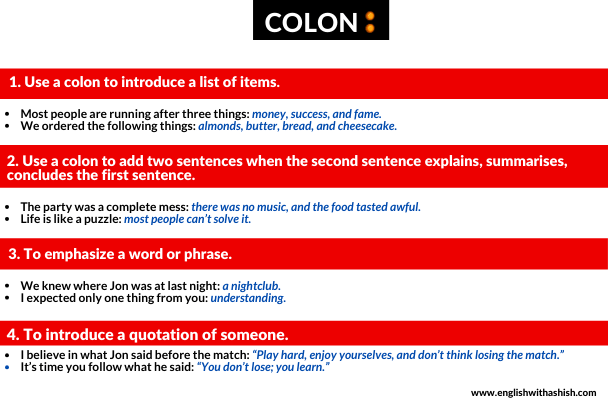
1. Use a colon to introduce a list of items.
A colon is used to introduce a list of items. Note that the colon must be followed by a complete sentence, not a fragment of a sentence.
Examples:
- Most people are running after three things: money, success, and fame.
- We ordered the following things: almonds, butter, bread, and cheesecake.
- The plan for the evening includes the following: going to a beach, playing basketball, and eating seafood.
- I want to visit four countries in my life: Myanmar, Australia, Singapore, and China.
Notice that it’s up to the choice of the writer whether they want to capitalize the first word after the colon. But if it’s a proper noun, the word must be capitalized.
NOTE: we often use colons to introduce a bulleted or numbered list.
There are 8 parts of speech in English:
- Nouns
- Pronouns
- Verbs
- Adjectives
- Adverbs
- Prepositions
- Conjunctions
- Interjections
Here are the parts of speech in English:
- Nouns
- Pronouns
- Verbs
- Adjectives
- Adverbs
- Prepositions
- Conjunctions
- Interjections
2. Use a colon to add two sentences when the second sentence explains, summarises, or concludes the first sentence.
Use colons to join two sentences if the second sentence justifies, explains, or emphasizes the first one. Here, the colon means “This is what I mean.”
- The date felt like an interrogation: she kept asking me questions.
What does the writer mean by “the date felt like an interrogation?” The colon introduces a clarification of the first sentence and explains what the writer meant.
The date felt like an interrogation = she kept asking me questions.
More examples:
- The party was a complete mess: there was no music, and the food tasted awful.
- He got what he deserved: he got thrown out of the company for misbehaving with colleagues.
- We have had enough of him: let’s fire him from the team.
- Life is like a puzzle: most people can’t solve it.
3. To emphasize a word or phrase.
We often use a colon to emphasize information that’s introduced by a colon. The word or phrase after the colon is dropped deliberately, making the situation a little dramatic.
Examples:
- She is after just one thing: money.
- We knew where Jon was at last night: a nightclub.
- I expected only one thing from you: understanding.
- They didn’t give him what he wanted: the papers of the property.
4. To introduce a quotation of someone.
We often use a colon to emphasize information that’s introduced by the colon.
Examples:
- I believe in what Jon said before the match: “Play hard, enjoy yourselves, and don’t think about losing the match.”
- It’s time you follow what he said: “You don’t lose; you learn.”
Now, let’s look at some important points related to using a colon in a sentence.
Important points to note
Capitalizing the first letter after the colon is a choice.
To capitalize the first word after the colon or not is a choice a writer has. There is no strict rule regarding that.
Examples:
- The date felt like an interrogation: she kept asking me questions. ✔️
- The date felt like an interrogation: She kept asking me questions. ✔️
Note that if the word coming after the colon is a proper noun, it must be capitalized.
- I see my future with only one person: Aaruhi.
- I see my future with only one person: aaruhi. ❌
Also note that if a colon follows a quotation, make sure the first letter of the first word post the colon is capitalized.
- We believe in what my father says before eating food: “Thank you God for everything that you gave us.”
- Ronny has my favorite quote on his laptop: “Change your thoughts, and change your world.”
Don’t use a colon after a fragment of a sentence.
Don’t use a colon if the part that it introduces is a part of the sentence:
- The object of the verb
- Subject complement
- The object of the preposition
Examples:
- She said: “I want to help you.” ❌
The clause coming after the colon is the object of the verb said. The object of the verb should not be separated from the verb. Hence, the use of the colon is unnecessary.
Correction: She said that want to help you. ✔️
We can use a colon in the sentence with some modifications.
- This is what she said: “I want to help you.” ✔️
- She said the following: “I want to help you.” ✔️
More examples:
- I love: teaching, dancing, and singing. ❌
(separating the object from its verb) - He is in need of: a job, a place, and a friend. ❌
(separating the object from its verb) - My hobbies are: playing cricket and reading books. ❌
(separating the subject complement from its linking verb) - The plan for the evening includes: going to a beach, playing basketball, and eating seafood. ❌
(separating the object from its verb)
These sentences are a step (removing the colon) away from being corrected.
Corrections:
- I love teaching, dancing, and singing.
- He is in need of a job, a place, and a friend.
- My hobbies are playing cricket and reading books.
- The plan for the evening includes going to a beach, playing basketball, and eating seafood.
Have a question or need deeper clarity? Drop it in the comments — I personally answer your questions/doubts.
If you found this lesson valuable, share it with peers or learners who will benefit. Let’s raise the standard of how we learn English — together.
Looking for personalised coaching to elevate your English, communication, and life skills?
I offer 1-on-1 mentorship that integrates advanced English fluency with emotional intelligence, confidence building, and personality development — designed to help you grow not just as a speaker, but as a powerful individual.
Reach out at [email protected] to get started.
On YouTube and Instagram, we break down real conversations, dive into pop culture, share quick grammar hacks, and do the things your textbook never could.
Follow now — and start learning smarter.

In American, “emphasise” is misspelt as “emphasize”. In English, “emphasise” is spelt “emphasise” correctly.
This article mentions “English”, but it actually goes on about American. English is the language of England; therefore, is English. American is not English. America should get its own language.
Thank you for the information, Bob!