This lesson helps us understand what a type zero conditional sentence is and how and when to use it correctly in English.
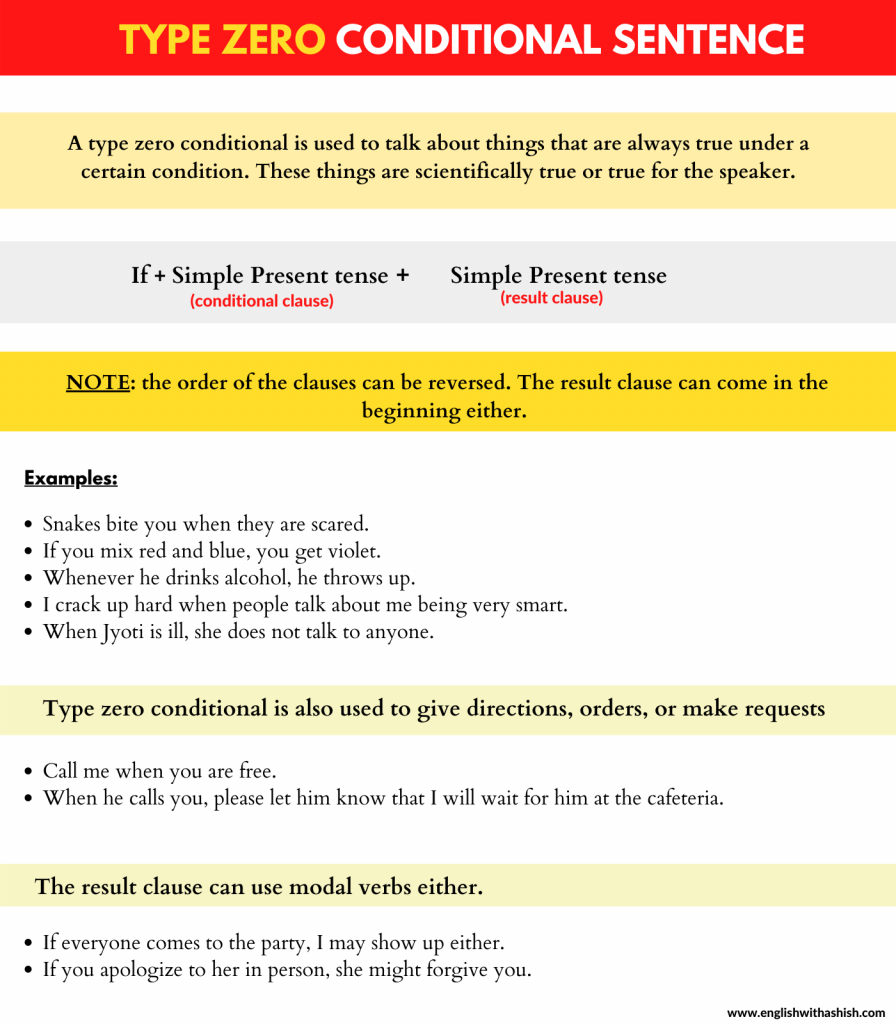
What is a type zero conditional sentence in English?
A type zero conditional is used to talk about things that are always true under a certain condition. These things are scientifically true or true for the speaker.
Take some ice from a fridge and wait for it to melt. What happens when it melts? If/when ice melts, it becomes water. Now, this is a type 0 conditional sentence. The outcomes of the condition (if ice melts) is true for everyone. It does not matter who does it. If you let ice melt, it will become water. It is a scientific fact.
Take red and yellow color, and mix it together. Do you know what happens when you do it? It becomes orange when you mix red and yellow together. It is also a fact, shown by using a type 0 conditional sentence.
Like any other conditional sentence, a type zero conditional sentence also has two clauses: a condition clause and a result clause. Here, the verb or verb phrases of both the clauses use the Simple Present tense. The condition starts with either ‘if’ or ‘when’.
Structures:
- Condition clause + comma + result clause
- Result clause + result clause
The order of the clauses can be reversed without altering the meaning of the sentence. Note that when the condition comes at the beginning, we use a comma after it and the result clause comes after the comma. But we don’t need a comma when the result clause comes before the condition.
NOTE: a type zero conditional sentence is also known as a type 0 conditional sentence, zero conditional sentence, conditional sentence type zero or conditional sentence type 0.
- If you don’t eat food for a long time, you get hungry.
We, here, have used the type 0 conditional sentence to talk about something that’s true under a certain condition. Notice that the result falls true for every human being. Both the clauses have used the Simple Present tense and the condition starts with ‘if’. Since it comes before the result clause, we have used a comma after it.
- When the sun goes down, it gets dark.
We are talking about an event that is scientifically true in a condition.
More examples:
- If you heat ice, it melts.
- Snakes bite you when they are scared.
- If you mix red and blue, you get violet.
- If you freeze water, it becomes solid.
- If you press the red button, the heater turns on.
An event (result) in a certain condition could be true for a person or a group of people.
- When we watch football at home, we always eat Chinese food.
- Rahul walks away when he is asked about his ex-girlfriend.
- I crack up hard when people talk about me being very smart.
- When Jyoti is ill, she does not talk to anyone.
- Whenever he drinks alcohol, he throws up.
- Max gets sick when he eats chicken.
- When I get bored, I play cricket.
The type zero conditional sentence is also used to give instructions/orders or request someone to do something in a situation. Here, the result clause uses the imperative structure: the subject of the clause is not used; it is implied.
- If you see my brother, ask him to call me right away.
We are asking someone to do something for us in a certain condition. The result clause does not have an explicit subject; the clause starts with the main verb directly like it is the case in imperative sentences. In imperative sentences, the implied subject is ‘you’.
- When he calls you, please let him know that I will wait for him at the cafeteria.
The speaker asks someone to do something under a certain condition. It is a request that the speaker has made.
More examples:
- Call me when you are free.
- Give me a call if you need more money.
- If she asks about me, tell her to call me.
- Don’t come to me whining and crying if she leaves you again.
- Don’t take the offer if they don’t pay you more than you were getting paid in your previous company.
- If you are not hungry, you don’t have to eat anything.
- Leave the hotel as soon as I call you.
- Please tell your sister to call me when she gets home.
The result clause in a type zero conditional sentence can use a modal verb instead of using the Simple Indefinite tense.
- If everyone comes to the party, I may show up either.
- If you apologize to her in person, she might forgive you.
- You should come if you are invited to the party.
- I can eat it all if I want to.
- If you work hard, you could pass the test.
Vocabularies used in the lesson
To throw up = to vomit
Show up = arrive or turn up for an event
Hope you, now, what a type zero conditional sentence is and how to use it correctly. Do share it with others to help and share your doubt, question, and feedback in the comment section.
Have a question or need deeper clarity? Drop it in the comments — I personally answer your questions/doubts.
If you found this lesson valuable, share it with peers or learners who will benefit. Let’s raise the standard of how we learn English — together.
Looking for personalised coaching to elevate your English, communication, and life skills?
I offer 1-on-1 mentorship that integrates advanced English fluency with emotional intelligence, confidence building, and personality development — designed to help you grow not just as a speaker, but as a powerful individual.
Reach out at [email protected] to get started.
On YouTube and Instagram, we break down real conversations, dive into pop culture, share quick grammar hacks, and do the things your textbook never could.
Follow now — and start learning smarter.
