If I asked you to describe your best friend or the job you are doing currently, the words you’d use to describe them would be descriptive adjectives. Knowingly or unknowingly, we describe people, things, or places. This post helps us master what a descriptive adjective is, and how to use it in a sentence correctly.
- What are adjectives?
- What is a descriptive adjective?
- Order of a descriptive adjective
- Important points to note
- Order of adjectives in a noun phrase
- Types of descriptive adjectives
- Hyphenated descriptive adjectives
- Comparison Table: Attributive vs Predicate Adjectives
- Common Mistakes with Descriptive Adjectives (and How to Avoid Them)
- Quiz Answers
What are adjectives?
Adjectives are words that give information about a noun/pronoun. Most adjectives in English are descriptive adjectives.
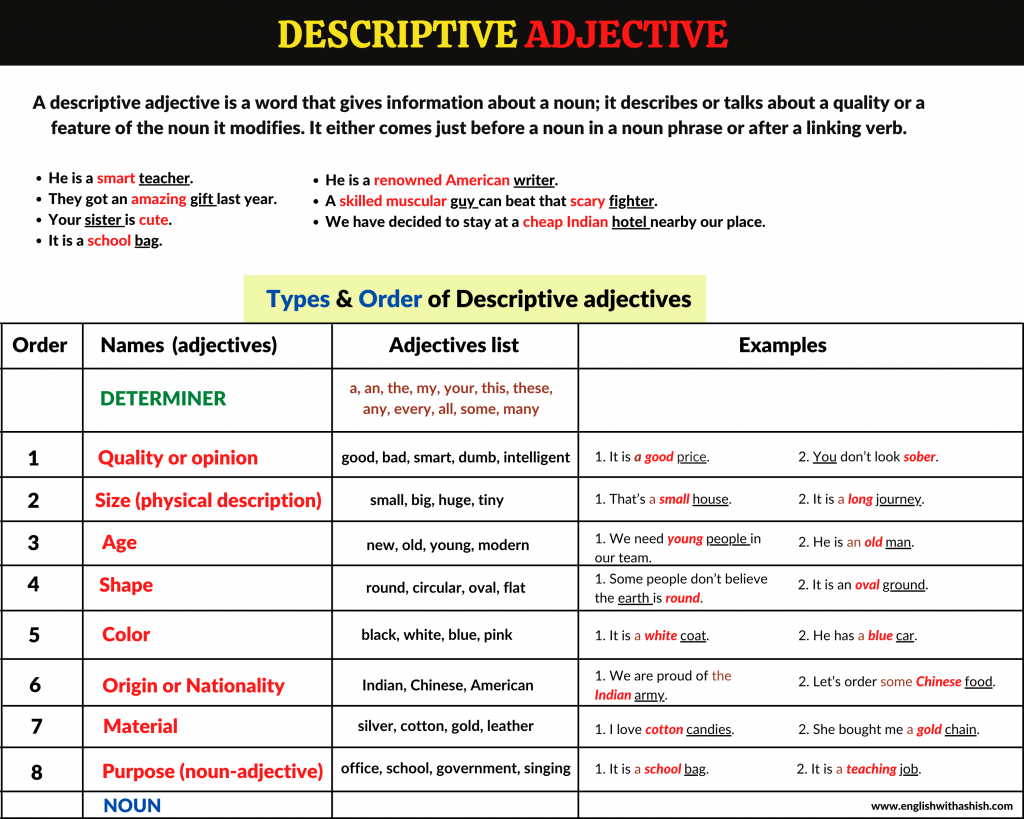
What is a descriptive adjective?
Descriptive adjective definition: it is a word that gives information about a noun; it describes or talks about a quality or a feature of the noun it modifies. It either comes just before a noun in a noun phrase or after a linking verb.
Let’s take some examples and understand how exactly descriptive adjectives, also known as qualitative adjectives, work.
- He is a smart teacher.
In the sentence, ‘smart’ is a descriptive adjective as it’s describing the noun ‘person’. The indefinite article ‘a’ coming before the adjective ‘smart’ is also working as an adjective, but it is a determiner that gives information about a noun; it is not a descriptive adjective.
- Riya is beautiful.
Noun = Riya
Descriptive adjective = beautiful (describing the physical quality of the person)
- They live in a huge house.
Noun = house
Descriptive adjective = huge (describing the size of the house)
- Some people say that the earth is flat, not round.
Noun = earth
Descriptive adjective = flat, round (describing the shape of the noun ‘earth’)
- I have participated in many singing competitions.
(Here, the word ‘singing’ is modifying the noun ‘competitions’.)
- We have some office work to do.
(Here, the word ‘office’, which often works as a noun, is describing the noun ‘work’.)
More examples:
- They got an amazing gift last year.
- Your sister is cute.
- Max bought a small brown chair last night.
- He is a renowned American writer.
- Look at the old man playing with those small kids.
- We have decided to stay at a cheap Indian hotel nearby our place.
- A skilled muscular guy can beat that scary fighter.
- It is a school bag.
In the above examples, the adjectives are in bold and the nouns they are describing are underlined.
Note that descriptive adjectives describe a noun in different ways; they can talk about the physical quality, shape, size, color, or many other things of a noun. so, it’s important to know the categories of descriptive adjectives and the order in which we use them.
Order of a descriptive adjective
A descriptive adjective can modify a noun in different ways. It’s important to understand all its heads and the right order in which we use them.
| Order | Descriptive adjectives categories | Adjectives | Examples (sentences) |
| 1 | Quality or opinion | good, bad, smart, dumb, intelligent, brave, coward, nice, expensive, petty, cheap, tiny, lovely, cute, helpful, arrogant, hardworking, sober, shrewd, logical, easy, difficult | 1. It is a good price. 2. You don’t look sober. 3. Give me a logical reason for this. 4. We need a strong man in our group. |
| 2 | Size (physical description) | small, big, huge, tiny, gigantic, short, mammoth, long | 1. That’s a small house. 2. It is a long journey. 3. This guy is huge in Dubai. |
| 3 | Age | new, old, young, modern, old-school, aged | 1. We need young people in our team. 2. He is an old man. 3. They have used modern technology in their production. |
| 4 | Shape | round, circular, oval, flat, square, triangular | 1. Some people don’t believe the Earth is round. 2. It is an oval ground. 3. The pitch is not flat yet. |
| 5 | Color | black, white, blue, pink | 1. It is a white coat. 2. He has a blue car. |
| 6 | Origin or Nationality | Indian, Chinese, American, Chinese, Italian | 1. We are proud of the Indian army. 2. Let’s order some Chinese food. 3. Chinese products are banned in India. |
| 7 | Material | silver, cotton, gold, leather, silk, plastic, iron | 1. I love cotton candies. 2. She bought me a gold chain. 3. Silk sarees are in vogue these days. |
| 8 | Purpose (noun-adjective) | office, school, government, singing, teaching | 1. In India, most people are running after a government job. 2. It is a school bag. 3. It is a teaching job. |
Examples:
1. Jon bought a lovely small old round red French wooden dining table yesterday.
(Opinion → Size → Age → Shape → Color → Origin → Material → Purpose + Noun)
2. I received a thoughtful little antique square golden Indian wooden jewelry box.
(Opinion → Size → Age → Shape → Color → Origin → Material → Purpose → Noun)
Important points to note
1. If two or more adjectives are taken from the same category to modify a noun, use commas to separate them. And use the conjunction ‘and’ before the last adjective.
- She is a smart and intelligent girl.
- His house is blue, red, and yellow.
Whether you punctuate your adjectives with a comma or the conjunction ‘and’ is a choice of your style of writing.
- She is a wonderful and passionate lady.
- She is a wonderful, passionate lady.
2. If two or more adjectives are taken from different categories to modify a noun, don’t use commas.
- That’s a nice pink Indian saree.
- We have outstanding modern gold jewelry.
- Jon is teaching some talented young brown students.
- She is my cute small American office friend.
Order of adjectives in a noun phrase
| Order of adjectives | Adjectives list | Examples |
| 1. Determiners | Determiners include the following: Articles = a, an, the Possessive adjective = my, our, his, her, your, its, their Demonstrative adjective = this, that, these, those Distributive adjective = each, every, all. either, neither… Quantifiers = some, many, a few, several… | 1. Do you have a watch? 2. I loved the party. 3. That building is very old. 4. I loved every performance today. 5. I will show you my office in the evening. 6. Some people are waiting for you outside. |
| 2. Numbers | one, two, three, first, second, third… | 1. We have two dogs. 2. She is my first girlfriend. |
| 3. Descriptive adjectives | good, bad, smart, dumb, small, big, old, young, round, flat, black, white, Indian, Chinese, cotton, gold, office, school | 1. Did you see the four American girls? 2. It is an expensive red and white table. 3. This is our first international project. 4. It was our second big mistake of the match. |
Types of descriptive adjectives
Descriptive, based on their positions in a sentence, are divided into categories:
- Attributive adjective
- Predicate adjective
Attributive adjectives
Adjectives that are placed before a noun are called attributive adjectives.
Examples:
- She is a talented person.
- I am looking for a cheap place to live in.
- It was an amazing movie.
- We have many cheap Chinese mobiles.
Predicate adjectives
These are adjectives or adjective phrases that come after a linking verb. A predicate adjective is also called a subject complement.
Examples:
- This house is vacant.
- Unlike yours, my job is challenging.
- She is adorable.
- The table is round.
QUIZ: Adjective Order Practice
1. Fill in the blank:
They found a ____ box in the attic. (small / mysterious / ancient / metal)
2. Rearrange the adjectives:
(German / powerful / new / sports / red / car)
3. Fill in the blank:
She wore a ____ dress to the party. (elegant / silk / black / long)
4. Rearrange the adjectives:
(funny / little / American / old / actor)
5. Fill in the blank:
We stayed in a ____ cottage by the lake. (cozy / wooden / beautiful / small / English)
Answers are provided at the end of the post.
Hyphenated descriptive adjectives
A hyphenated adjective is formed using two or more words, generally two. Let’s look at all the possible combinations of hyphenated adjectives in English.
1. Number + noun
- 3-hour journey
- Thirty-member committee
- Ten-minute break
- Three-month anniversary
- Ten-story building
- Six-month suspension
- Third-party insurance
Examples:
- Let’s take a 10-minute break.
- We are celebrating our three-month anniversary.
- They gave him a six-month suspension for failing the drug test.
Note: Make sure the noun you use in the hyphenated adjective is singular. Making it plural is a common mistake.
- Let’s take a 10-minutes break. ❌
- We are celebrating our three-months anniversary. ❌
2. Adjective + past participle
- Narrow-minded people
- Old-fashioned hotel
- High-spirited
- Absent-minded people
- Kind-hearted
- High-spirited performance
Examples:
- She is a narrow-minded girl.
- Everyone loves being around high-spirited people.
- What a kind-hearted man he is.
3. Adverb + past participle
- Well-organized party
- Well-behaved person
- Highly-respected man
- Widely-recognized singer
- Commonly-consumed drug
- Densely-populated area
- Poorly-planned event
Examples:
- It was a well-organized party.
- He lives in a densely-populated area.
- His brother is a widely-recognized investor.
4. Adjective + present participle
- Good-looking man
- Long-lasting performance
- Easy-going person
Examples:
- What a good-looking guy he is.
- He is not an easy-going person.
5. Adverb + present participle
- Never-ending process
- Slow-moving car
- Forward-thinking man
Ex – Learning a language is a never-ending process.
6. Noun + past participle
- Man-made houses
- hand-made sleepers
- Coal-powered trains
Examples:
- These are not hand-made cookies.
- Coal-powered trains were stopped years back.
7. Noun + present participle
- Thought-provoking idea
- English-speaking course
- Mouth-watering food
- Eye-catching painting
- Record-breaking event
- Mind-blowing performance
Examples:
- It was a mind-blowing performance.
- She makes mouth-watering food.
8. Noun + adjective
- Brand-new car
- World-famous singer
- Gluten-free meal
Examples:
- They got me a brand-new car.
- You should try gluten-free meals.
Comparison Table: Attributive vs Predicate Adjectives
| Type | Position | Example | Rule |
| Attributive | Before noun | a brilliant idea | Stands before what it modifies |
| Predicate | After linking verb | The idea is brilliant. | Follows linking verbs like is, seems, feels |
Common Mistakes with Descriptive Adjectives (and How to Avoid Them)
Many English learners use descriptive adjectives incorrectly in terms of order, punctuation, form, and placement. Below are the most common errors — explained with examples:
1) Using Commas Between Adjectives from Different Categories
❌Mistake:
Learners often insert commas between adjectives that come from different categories, such as opinion, color, nationality, etc.
Incorrect:
She wore a beautiful, pink, Indian saree. ❌
(Here, commas separate adjectives from different types: opinion, color, origin)
✅ Correct:
She wore a beautiful pink Indian saree.
(No commas because each adjective belongs to a different category and follows the standard order)
Rule:
Don’t use commas between adjectives from different classes. Use commas only when adjectives are from the same category (e.g., multiple opinions or colors).
Use commas here:
a smart, funny, kind girl (All = opinion adjectives)
No commas here:
a smart young Indian girl (opinion + age + origin)=
2) Hyphenating Adjectives Incorrectly (Especially Number + Noun)
❌Mistake:
Learners often:
- Forget to hyphenate compound adjectives
- Use plural nouns after numbers within compound modifiers
Incorrect:
Let’s take a 10-minutes break. ❌
(“minutes” is plural — wrong when used as part of a compound adjective)
✅ Correct:
Let’s take a 10-minute break.
(“10-minute” acts as one adjective unit before the noun “break”)
Rule
When a number + noun is used as an adjective before another noun, hyphenate it, and keep the inner noun singular.
Examples:
- a three-hour movie ✅
a two-day workshop ✅ - a five-story building ✅
But if the number and noun come after the verb, no hyphen is needed:The break was 10 minutes long. ✅
3) Forgetting to Use Articles or Determiners Before Descriptive Adjectives
❌Mistake:
Descriptive adjectives in noun phrases are often missing a determiner (like a, the, my, some).
Incorrect:
I saw beautiful girl at the market. ❌
✅ Correct:
I saw a beautiful girl at the market. ✅
Rule:
Most descriptive adjectives in noun phrases require a determiner before them — unless the adjective is part of a structure like “I find X Y” or follows certain exceptions.
Common Determiners:
- Articles: a, an, the
- Possessives: my, his, their
- Demonstratives: this, that, those
- Quantifiers: some, many, few
More Correct Examples:
- We adopted a friendly dog. ✅
- He gifted me an expensive watch. ✅
- She met some interesting people. ✅
Quiz Answers
- a mysterious small ancient metal box
- a powerful new red German sports car
- an elegant long black silk dress
- a funny little old American actor
- a beautiful small cozy wooden English cottage
Do leave your feedback in the comment box and share the post with others to help them get better.
1. What is a descriptive adjective in English grammar?
A descriptive adjective is a word that describes the qualities, features, or characteristics of a noun. It tells us what kind, how something looks, feels, sounds, or behaves.
Example: She wore a beautiful dress. (Here, beautiful describes the noun dress.)
2. What’s the correct order of descriptive adjectives?
In English, multiple adjectives follow a specific order:
Opinion → Size → Age → Shape → Color → Origin → Material → Purpose + Noun
Example: A lovely small old round red Italian wooden coffee table
3. What’s the difference between attributive and predicate adjectives?
Attributive adjectives come before the noun: a talented actor
Predicate adjectives come after linking verbs and describe the subject: The actor is talented.
4. Can I use commas between descriptive adjectives?
✅ Use commas when adjectives are from the same category: a smart, hardworking, humble man
❌ Don’t use commas if the adjectives belong to different categories: a tall young Indian player
5. What are hyphenated descriptive adjectives?
Hyphenated descriptive adjectives are formed by joining two or more words to modify a noun.
Examples:
A ten-minute break
A well-organized event
A mouth-watering dish
Have a question or need deeper clarity? Drop it in the comments — I personally answer your questions/doubts.
If you found this lesson valuable, share it with peers or learners who will benefit. Let’s raise the standard of how we learn English — together.
Looking for personalised coaching to elevate your English, communication, and life skills?
I offer 1-on-1 mentorship that integrates advanced English fluency with emotional intelligence, confidence building, and personality development — designed to help you grow not just as a speaker, but as a powerful individual.
Reach out at [email protected] to get started.
On YouTube and Instagram, we break down real conversations, dive into pop culture, share quick grammar hacks, and do the things your textbook never could.
Follow now — and start learning smarter.

Wooowww…
It was an amazing article.
Really impressive! Keep up the good work✨
Glad you liked the post, Jyoti!