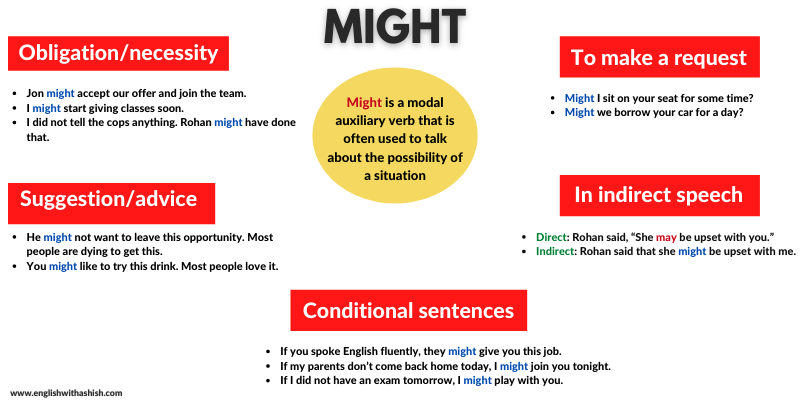
Might is a modal auxiliary verb that is often used to talk about the possibility of a situation. In this post, we will learn all the different usages of might in English.
1. To talk about an obligation/necessity
We use might to talk about the possibility of a situation. The speaker does not feel positive about the possibility of the situation using might; might refers to a weak possibility.
Examples:
- Jon might accept our offer and join the team.
- I might start giving classes soon.
- My father might ask you questions about what happened last night at the party.
- I did not tell the cops anything. Rohan might have done that. (past)
- He was not talking to anyone yesterday. He might have been ill.
- She might not come to the party tonight.
2. To give suggestion/advice
We often use might to give a suggestion. But the suggestion is not straight or direct here; using might to give suggestions or advice sounds very polite.
Examples:
- You might want to join us tonight since you have nothing to do.
- He might want to watch this movie. It is one of the best movies I have watched.
- He might not want to leave this opportunity. Most people are dying to get this.
- You might like to try this drink. Most people love it.
- Tom: I am going to fail this exam. What should I do?
- Jerry: You might want to talk to Ashish. He can help you pass the exam.
3. To make a request
Might is used to make formal requests or ask for a permission. It is a very formal word for making a request and is often not used in modern English.
Examples:
- Might I sit on your seat for some time?
- Might we borrow your car for a day?
- Might I interrupt you and show you something?
NOTE: we answer the request using might with the modal can or could.
- Max: Might I use your phone for a moment?
- Akshay: Yes, you might. ❌
- Max: Might I use your phone for a moment?
- Akshay: Yes, you can/could. ✔️
- Max: Might I borrow your bike?
- Akshay: No, you can’t. ✔️
4. In indirect speech
May is changed into might in the indirect speech.
Examples:
- Direct: Rohan said, “She may be upset with you.”
- Indirect: Rohan said that she might be upset with me.
- Direct: He told me, “Riya may call you tonight.”
- Indirect: He told me that Riya might call me that night.
5. Conditional sentences
Might is used in conditional sentences to show the possibility of a situation.
Examples:
- If you spoke English fluently, they might give you this job.
- If my parents don’t come back home today, I might join you tonight.
- If I did have an exam tomorrow, I might play with you.
- If they had increased my package, I might have worked there longer.
Have a question or need deeper clarity? Drop it in the comments — I personally answer your questions/doubts.
If you found this lesson valuable, share it with peers or learners who will benefit. Let’s raise the standard of how we learn English — together.
Looking for personalised coaching to elevate your English, communication, and life skills?
I offer 1-on-1 mentorship that integrates advanced English fluency with emotional intelligence, confidence building, and personality development — designed to help you grow not just as a speaker, but as a powerful individual.
Reach out at [email protected] to get started.
On YouTube and Instagram, we break down real conversations, dive into pop culture, share quick grammar hacks, and do the things your textbook never could.
Follow now — and start learning smarter.

Sir apne fees structure nh bataya mujhe join krna hai
Regards
Himanshu
8827868679