This post helps us understand what an imperative sentence in English is, what it does, and when to use it.
What is an imperative sentence in English?
An imperative sentence is a sentence that expresses a command, order, instruction, request, suggestion, moral duty or warning. It does not have an explicit subject: the subject is not present in an imperative sentence; it is implied.
These sentences tell you what to do or what not to do. The tone with which the speaker says it makes it a command, instruction, order, request or something else.
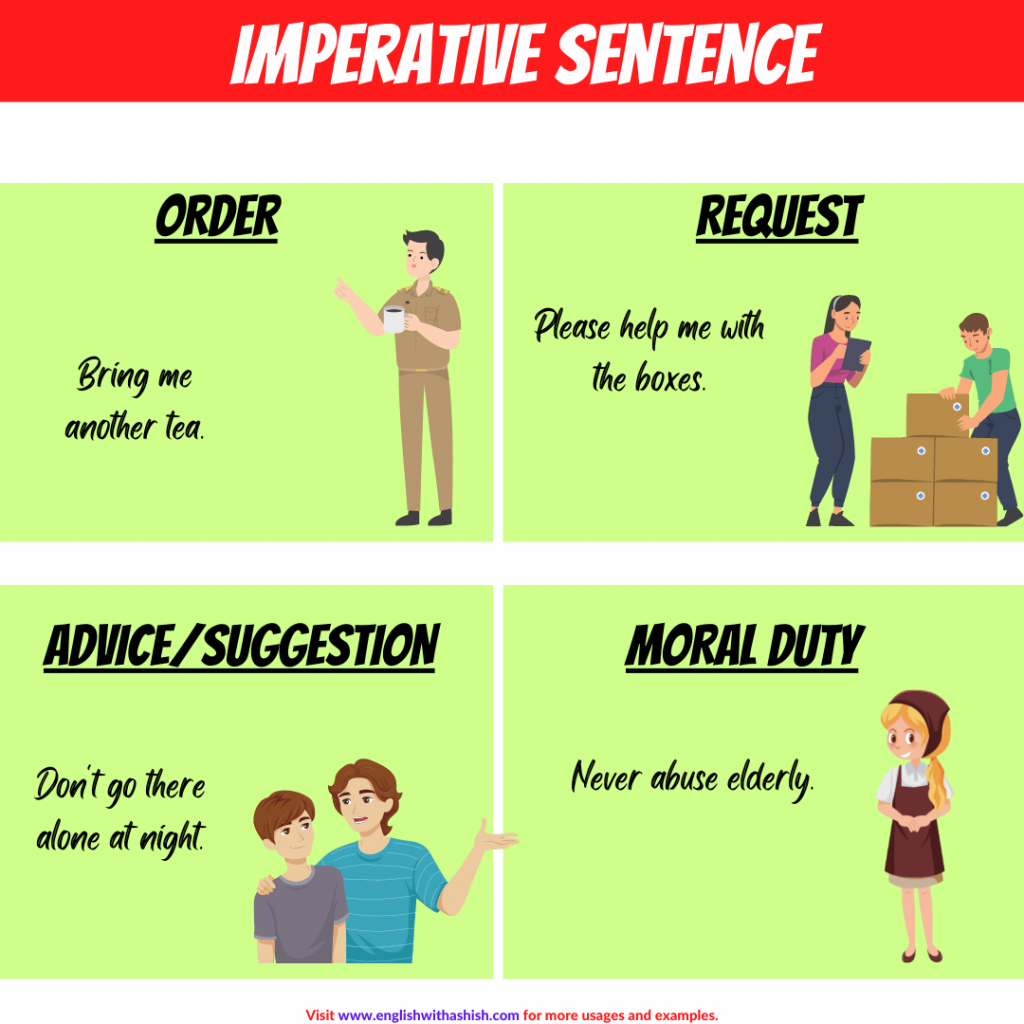
Examples:
- Cook something good for me.
- Wait outside my room.
- Please pick up my father from the airport.
- Don’t call me at night.
- Don’t go there alone at night.
- Come here fast.
- Never take food from strangers.
- Tell me your name.
- Do me a favor.
- Don’t judge a book by its cover.
- Laugh when he cracks a joke.
- Don’t make Jon mad.
- Never underestimate your opponent.
- Help the needy.
You must have noticed that we don’t have a subject present in these sentences. The implied subject here is ‘you‘. We don’t use the subject ‘you’ in imperative sentences as we are directly giving the order, command or something else to the person being addressed.
You wait outside my room. (explicit subject)
Wait outside my room. (implied subject)
ORDER/COMMAND/INSTRUCTION
- Bring the file to my myself.
- Ask Rohit to wait in my personal room.
- Go to your room right now.
- Come to office.
- Cook me pasta the way I like it.
- Park the car outside the main gate.
The tone with which you deliver the message makes it a command, order or instruction.
REQUEST
The word please makes it clear that the sentence expresses a request.
- Please help me with this question.
- Look into this matter please.
- Please ask him to talk to me for once.
- Please give me a job. I really need one.
SUGGESTION
- Try talking to Rohan about it. He may help.
- Do this on your own for some time before taking anyone’s help.
- Try this with some cream on top of it. You will love it!
- Don’t take water after coming from a long run.
- Take some bananas with milk. It will help you gain faster.
MORAL/LEGAL DUTY
- Never abuse elderly.
- Always offer your seat to a lady or a sick person.
- Don’t smoke in front of children.
- Respect your parents.
WARNING
- Don’t touch me. I will call the cops on you.
- Don’t eat candies in front of boss; he will fire you in no time.
- Don’t eat fish with milk. It does not go well with our stomach.
- Be careful of the bulls. They are wild.
- He is furious and has a gun in his hand. Don’t try talking to him now.
OFFER/PROPOSAL
- Marry me.
- Come work with me. I will pay you more than you’re getting paid.
- Sign and papers and take the money.
- Take my car to the date.
- Come live with us
How to identify an imperative sentence?
Imperative sentences are not too far away from being called a declarative or an exclamatory sentence. The period at the end, and not expressing a strong emotion is what makes it imperative, not others.
Using an exclamation mark at its end will make it an exclamatory sentence, and adding a subject to it (explicit) will make it declarative or exclamatory, depending upon the punctuation mark it ends with.
- She kisses me. (declarative)
- Kiss me. (imperative)
- Kiss me! (saying it without a strong feeling: exclamatory)
Declarative sentences always have a subject, and exclamatory sentences may or may not have it, but an imperative sentence never has a subject in the sentence. We can’t mistake an imperative sentence for a declarative sentence as the latter always has a subject present in it, and the former doesn’t. And we shouldn’t also mistake it for an exclamatory sentence as the latter always ends with an exclamation mark and the former with a period.
A sentence might express an order yet not be called imperative.
The presence of the subject makes the difference here. Study the following examples to understand this.
- I want you to get me a glass of water. (declarative)
- Get me a class of water. (imperative)
Both sentences express a command and end with a period, but they are not the same: the first is a declarative sentence, and the second is an imperative sentence. The presence of the subject makes it declarative though it does the same job an imperative sentence does.
More examples:
- You should not go there alone.
- Don’t go there alone.
- I request you to come with us.
- Please come with us.
- We offer you to join our company for better future security..
- Join our company for better future security.
Have a question or need deeper clarity? Drop it in the comments — I personally answer your questions/doubts.
If you found this lesson valuable, share it with peers or learners who will benefit. Let’s raise the standard of how we learn English — together.
Looking for personalised coaching to elevate your English, communication, and life skills?
I offer 1-on-1 mentorship that integrates advanced English fluency with emotional intelligence, confidence building, and personality development — designed to help you grow not just as a speaker, but as a powerful individual.
Reach out at [email protected] to get started.
On YouTube and Instagram, we break down real conversations, dive into pop culture, share quick grammar hacks, and do the things your textbook never could.
Follow now — and start learning smarter.
