This post will help you understand when and how to use the Future Perfect Continuous tense in English.
When to use the Future Perfect Continuous tense?
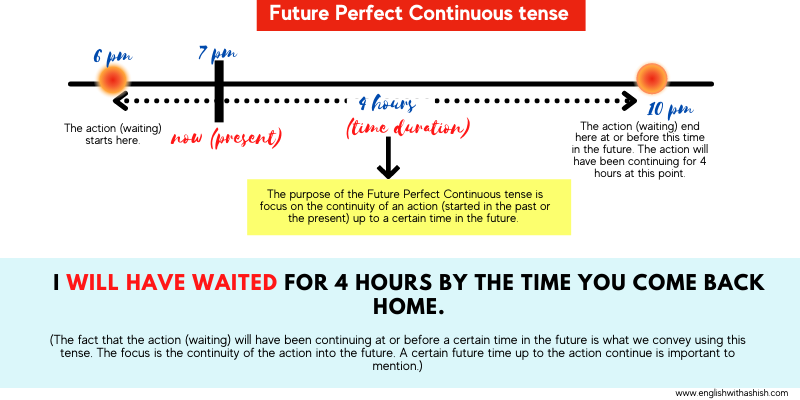
The Future Perfect Continuous tense is used to refer to an action or a situation that will have been continuing for some time at a certain time in the future or before a certain time or action in the future.
1. To focus on the fact an action will be continuing for a certain time duration at a specific time in the future
I will have been working on this idea for 2 years in December.
There’s an idea that I have been working on. The purpose of using the future perfect continuous tense here is to show for how long the action will have been going on at a certain time in the future, which is December here.
The action may or may not continue after that point, but that’s not what we are focusing on here. We are just focusing on the time duration for which this action will have been going on at this point in the future.
Next week, Joe and I will have been living together for 10 years.
We have been living together, and we don’t have any intention of parting our ways. I am using the future perfect continuous tense to highlight the time duration that it’ll have been going on for at a certain time in the future. At this time (next week), this action (living together) will have been going on for 10 years. This is what we’re focusing on using this tense.
Whether the action will continue happening post that time is not what we are not focusing on. Though, we don’t have reason to say that the action will not still be taking place post that point.
More examples:
- At midnight, we will have been playing cards for 8 hours.
- Next month, he will have been playing football professionally for a decade.
- In June, Daniel will have been working here for 5 years.
2. To focus on the fact an action will be continuing for a certain time duration before it stops, before a specific time or an action in the future
I will have been waiting for almost 4 hours when you arrive at the hotel.
Let’s say it’s 4 pm right now, and I am at a hotel, waiting for you to join me. I came here and started waiting at 3 pm. So, now (at 4 pm), I give you a call and ask you when you’ll be here. You tell me that you will arrive at the hotel at 7 pm. Hearing this, I say that at this time (when you arrive), I will have been waiting for 4 hours. The focus here is on the fact that before a certain time (your arrival at 7 pm), this action will have been going on for a certain time duration.
He will have been driving for almost 12 hours by the time we reach the destination.
Again, the focus is on the fact that this action (driving) will have been continuing for a certain time duration before a certain time, which is indicated by an action (reaching the destination).
More examples:
- We will have been working at the university for 4 hours when the college closes.
- Ashish will have been teaching here for 10 years before he moves to Nepal.
- Jon will have been fighting for 4 years when his contract gets over.
- I will have been using this laptop for 6 years when he buys it off me.
3. To describe the cause of a state in the future
Here, the action in the Future Continuous Perfect tense works as a reason for a certain state of being in the future at a point.
Your legs will be numb at night as you will have been running all day.
The first clause refers to a certain state in the future, and the clause in the Future Perfect Continuous tense refers to an action that works as the reason for the state.
Examples:
- I will be sleepy by the time the party starts because I had been driving the whole day.
- They will be red at night as they will have been running all day.
Future Perfect Continuous tense structures
Affirmative
| Subject + | will have been + | present participle (V1+ing) |
- I will have been working here this Sunday.
- By the time your friend comes, the class will have been going on for 4 hours.
- At 6 ‘o clock, we will have been sitting here and waiting for almost an hour.
Negative
| Subject + | will not have been | present participle (V1+ing) |
- I will not have been waiting here by the time you come.
- You will not have been running enough to clear the test.
- Jimmy won’t have been sleeping at 12 ‘o clock.
Interrogative
| Will + | subject + | have been + | present participle (V1+ing)? |
- Will you have been talking to the kids at 10 pm?
- Will he have been sleeping when I arrive?
Interrogative negative
| Will + | subject + | not + | have been + | present participle (V1+ing)? |
- Will you not have been talking to the kids at 10 pm?
- Will he not have been sleeping when I arrive?
Alternative structure
| Won’t | subject + | have been + | present participle (V1+ing)? |
- Won’t you have been talking to the kids at 10 pm?
- Won’t he have been sleeping when I arrive?
You, now, know what the Future Perfect Continuous tense is and how to use it correctly in a sentence. Do share the lesson with others to help them.
Have a question or need deeper clarity? Drop it in the comments — I personally answer your questions/doubts.
If you found this lesson valuable, share it with peers or learners who will benefit. Let’s raise the standard of how we learn English — together.
Looking for personalised coaching to elevate your English, communication, and life skills?
I offer 1-on-1 mentorship that integrates advanced English fluency with emotional intelligence, confidence building, and personality development — designed to help you grow not just as a speaker, but as a powerful individual.
Reach out at [email protected] to get started.
On YouTube and Instagram, we break down real conversations, dive into pop culture, share quick grammar hacks, and do the things your textbook never could.
Follow now — and start learning smarter.

FUTURE PERFECT CONTINUOUS TENSE
INCORRECT: I WILL HAVE WAITED FOR 4 HOURS BY THE TIME YOU COME BACK HOME.
CORRECT: I WILL HAVE BEEN WAITING FOR 4 HOURS BY THE TIME YOU COME BACK HOME.