This lesson will help you understand what an adverbial complement is and what it does in a sentence.
What is an adverbial complement?
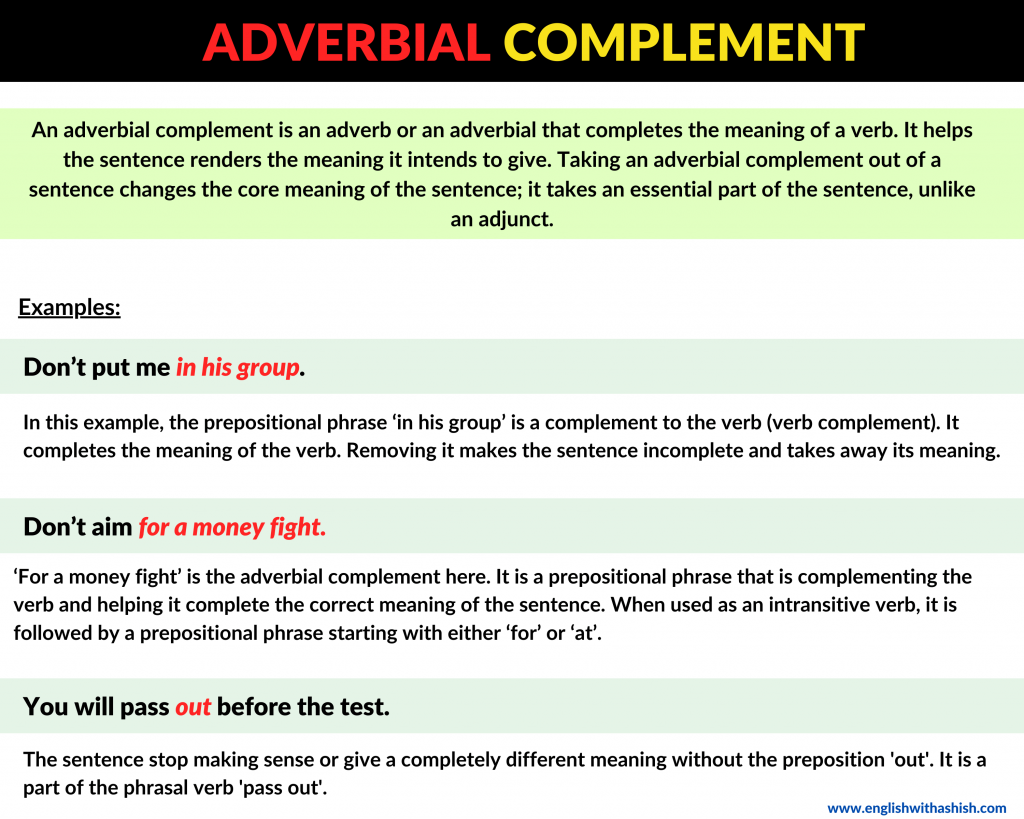
An adverbial complement is an adverb or an adverbial that completes the meaning of a verb. It helps the sentence render the meaning it intends to give. Taking an adverbial complement out of a sentence changes its core meaning; it takes an essential part of the sentence, unlike an adjunct.
It is a type of verb complement as it helps to complete the meaning of a verb.
Examples:
- Don’t put me in his group.
In this example, the prepositional phrase ‘in his group’ is a complement to the verb ‘put’. Removing it makes the sentence incomplete and takes away its meaning. You put something somewhere; not mentioning the place where you put something will make the sentence lose its meaning and make it incomplete.
- I love coming here.
Here, the adverb ‘here’ is a complement to the verb ‘coming’. You don’t just come; you come to a place. So, mentioning the place is important. The place has to be combined with the verb. Taking the verb complement out of the sentence makes it sound incomplete (I love coming). When you look at this sentence without the adverb, the question ‘where’ organically comes to your mind.
- Don’t aim for a money fight.
‘For a money fight’ is the adverbial complement here. It is a prepositional phrase that complements the verb and helps it complete the correct meaning of the sentence. When used as an intransitive verb, it is followed by a prepositional phrase starting with either ‘for’ or ‘at’.
- We are aiming at the manager’s post.
When you aim at something, you plan to achieve it. Without using the prepositional phrase starting (at + object), this meaning can’t be delivered. Without the verb complement, the sentence (We are aiming) is incomplete and does not render the intended meaning.
- Please behave like a professional.
Behave, as a transitive verb, is always followed by an adverbial of manner. It is essential to talk about how someone behaves. Not adding the adverbial complement to the sentence makes the sentence change its meaning. Look at this example: Please behave. Looking at the sentence, you feel like asking ‘how’. Behave how.
Some examples using the verb ‘behave‘:
- I can’t behave like you.
- You are behaving properly.
- He was behaving like a child on the stage.
More examples of adverbial complements
- We are staying at a hotel.
- Don’t get into his business.
- She is not taking me seriously.
Phrasal verbs and adverbial complements
A phrasal verb is a combination of an action verb and a preposition. The preposition in the phrasal verbs changes the meaning of the verb. The phrasal verb often has a different meaning from the verb alone.
Here are some common phrasal verbs in English:
- Pass out
- Break up
- Look up to
- Get through
- Go after
Notice that the first word in these phrases is an action and the next word/s is a preposition. Let’s look at some examples using these phrasal verbs:
- You will pass out before the test.
- I can’t break up with her.
- We look up to your father.
- You will get through this problem.
- The police are going after you.
The preposition in these phrasal verbs is the adverbial complement. Try reading these sentences without the preposition. The sentences stop making sense or give a completely different meaning without the preposition.
Adverbial complement vs Adjunct
An adjunct is completely opposite to an adverbial complement. An adjunct is often an adverbial that is optional and does not change the meaning of a sentence or make it ungrammatical. One needs to be careful before calling a part adjunct or adverbial complement. One needs to look at how an adverb is affecting a verb. If it is essential to the meaning of the verb, call it a complement, if it’s not, it is just an adjunct.
Adverbial complement vs Adjunct study table
| Sentences with adverbials | without adverbials | Is the adverbial essential? Does the meaning change? |
| Put me on this program. | Put me. | Yes. The sentence looks incomplete without it. It is an adverbial complement. |
| I was playing in the garden. | I was playing. | No. It is not essential. It is an adjunct to the sentence. |
| Call me now. | Call me. | No. It is not essential. It is an adjunct to the sentence. |
| Don’t look into the mirror. | Don’t look. | Yes. It is essential to complete the meaning of the sentence. (adverbial complement) |
How to Identify an Adverbial Complement (Checklist)
Whenever unsure or confused as to a part in a sentence is an adverbial complement or not, ask these questions:
- Is the verb incomplete without it?
- Does the verb’s meaning depend on it?
- Does removing it change the core intent?
- Does it feel like the sentence leaves you hanging?
Practice set!
Study the following sentences and identify the adverbial complements:
- Don’t look at me.
- I live in a village.
- They were partying on your terrace.
- You should go to bed now.
- The kids were shouting in the classroom.
- They quickly changed their game plan.
- You should not put this in his tea.
- Will you look after my kids?
The answers to the questions are provided at the end of the post.
List of Common Verbs That Take Adverbial Complements
These are some of the most common verbs that are often seen to be followed by an adverbial complement:
- Put
- Go
- Stay
- Aim
- Live
- Sit
- Behave
- Look (when followed by prepositions)
| Why it Needs an Adverbial Complement | Correct Example | Incomplete/Incorrect Example |
|---|
| Put | You always put something somewhere – the place is essential. | Put the keys on the table. | Put the keys. ❌ (Where?) “Put” requires a destination or location — where you put something. |
| Go | The direction or destination is necessary to complete the idea. | She went to the market. | She went. ❌ (Where to?) “Go” implies movement — the destination is essential to complete the meaning. |
| Stay | Location or condition must be mentioned to give meaning. | We’re staying at a hotel. | We’re staying. ❌ (Where?) “Stay” needs a location — without it, the sentence feels incomplete. |
| Aim | Requires a goal or direction for clarity of intent. | He’s aiming for the top position. | He’s aiming. ❌ (At what?) “Aim” needs a goal or target — otherwise, the action has no clear object. |
| Live | Needs a place to express full meaning. | They live in Mumbai. | They live. ❌ (Where?) “Live” always needs a place — otherwise the meaning is vague or incomplete. |
| Sit | Often needs a place or position to complete the action. | Sit on the chair. | Sit. ✅/❌ (Grammatically okay, but vague.) “Sit” needs a specific location to make the action complete. |
| Behave | Usually followed by manner (how?) – essential to clarify behavior. | Please behave like a professional. | Please behave. ❌ (How?) “Behave” needs manner — without it, the reader is left asking how? |
| Look | When followed by prepositions, it needs a complement to clarify. | Don’t look into the mirror. Certain prepositions after “look” complete the phrasal meaning (e.g., look at, look into). |
Practice set answers:
- at me
- in a village
- No adverbial complement
- to bed
- No adverbial complement
- No adverbial complement
- in his tea
- after
Have a question or need deeper clarity? Drop it in the comments — I personally answer your questions/doubts.
If you found this lesson valuable, share it with peers or learners who will benefit. Let’s raise the standard of how we learn English — together.
Looking for personalised coaching to elevate your English, communication, and life skills?
I offer 1-on-1 mentorship that integrates advanced English fluency with emotional intelligence, confidence building, and personality development — designed to help you grow not just as a speaker, but as a powerful individual.
Reach out at [email protected] to get started.
On YouTube and Instagram, we break down real conversations, dive into pop culture, share quick grammar hacks, and do the things your textbook never could.
Follow now — and start learning smarter.

Ashish sir,
Could you plz help to make me understand a sentence
I am here.
Here is what complement to sub or verb ……
Hi kajal,
More technically, the word ‘here’ works as a verb complement. Looking at it syntactically, it functions as a subject complement too, for it comes after a linking verb and provides information about the subject.
Here, it is an adverb complement, and in adverb complement, it is an adverbial modifier. It is describing the word verb not a subject.
Hai Ashish,
I’m Akshay, please clarify me the below sentence:
I love coming here
is love in the above sentence acting as a main or helping verb, can action verbs also act as helping verbs. “Coming here” can work as gerund phrase, can’t it?
I’m bit confused about this sentence, please clarify, thank you!
Hi Akshay,
Let me break down the sentence for you.
I love coming here.
I – subject
love – main verb (transitive)
coming here (gerund phrase working as the object of the verb ‘love’)