This post will help us understand what sentence adverbs are, and how to use them in a sentence.
What is a sentence adverb?
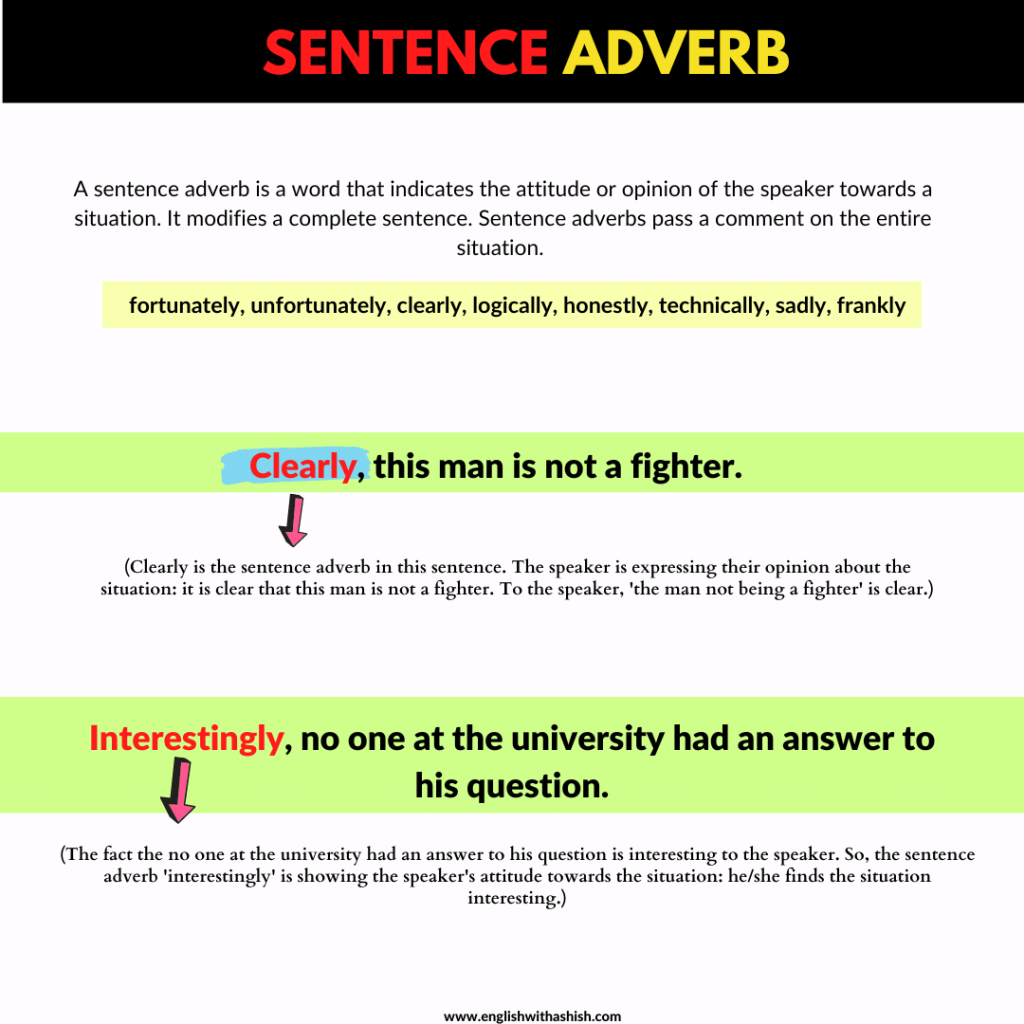
Definition: a sentence adverb is a word that indicates the attitude or opinion of the speaker towards a situation. It modifies a complete sentence. Sentence adverbs pass a comment on the entire situation.
Common sentence adverbs: fortunately, unfortunately, clearly, logically, honestly, technically, sadly, frankly, smartly, stupidly, wisely, apparently, surprisingly, theoretically, seriously, thankfully, naturally, ideally, indeed, etc.
Examples of sentence adverbs
- Clearly, this man is not a fighter.
(Clearly is the sentence adverb in this sentence. The speaker is expressing their opinion about the situation: it is clear that this man is not a fighter. To the speaker, ‘the man not being a fighter’ is clear.)
- Sadly, Jane is not a part of our team.
(To the speaker, it is sad that Jane is not a part of the team. Sadly is a sentence adverb here.)
- Interestingly, no one at the university had an answer to his question.
(The fact that no one at the university had an answer to his question is interesting to the speaker. So, the sentence adverb ‘interestingly‘ is showing the speaker’s attitude towards the situation: he/she finds the situation interesting.)
Notice that these words are modifying the complete sentences; they are not modifying a particular word in the sentence. But when they modify a particular part of the sentence (generally a verb), they don’t work as sentence adverbs.
- Jon interestingly completed the task. (modifying the verb ‘completed’ and telling us ‘in what manner’ the action took place)
- Meera sadly opens her Christmas present. (modifying the verb ‘opens’ and telling us how the action takes place: in a sad manner)
- She explained everything clearly. (modifying the verb ‘explained’ and telling us ‘in what manner’ the action took place: in a clear manner)
Notice that in these sentences, the words (interestingly, sadly, clearly) are modifying a part of the sentence, not the complete sentence.
More examples of sentence adverbs
- Honestly, Jon lost the watch. (=To be honest, he lost the match.)
(The speaker is honest when he/she says that Jon lost the match. The sentence adverb is the speaker’s attitude towards the situation.)
- Unfortunately, Sheldon wasn’t carrying his phone to record what happened.
(It is unfortunate (to the speaker) that Sheldon wasn’t carrying his phone to record the event.)
- Hopefully, you’ll get a good job soon.
(The speaker is hopeful about the situation.)
- Frankly, I never wanted to work with them.
(The sentence adverb is showing the speaker’s attitude towards the situation: he is frank about it.)
- Apparently, no one wants to talk to us.
(It is apparent to the speaker (his/her opinion) that no one wants to talk to us.)
- Fortunately, Max was there to help me.
(Fortunately is the sentence adverb here. It shows the speaker’s attitude towards the sentence: it was fortunate that Max was there to help me.)
FAQs
What is a sentence adverb?
A sentence adverb is a word that modifies an entire clause. It often shows the speaker’s opinion about the clause it modifies. Ex – Hopefully, our team will win the match. The word ‘hopefully’ modifies the entire sentence and indicates the speaker’s take on the situation.
How to use a sentence adverb?
A sentence adverb is used to give information (describe) about an entire clause. It indicates the speaker’s opinion/take on the clause it modifies.
Hope you enjoyed the lesson . Feel free to share your question, doubt, or feedback in the comment section, and also, share the post with the people that need it.
For one-on-one classes, contact me at [email protected].
