In this post, we learn what an object complement is, and how to use and identify it.
What is an object complement?
Object complement definition: An object complement is a word or a group of words (phrase) that comes after a direct object, identifies it, and either renames it or modifies it (what state it has entered). Note that a noun as an object complement renames the object, and an adjective as an object complement modifies it.
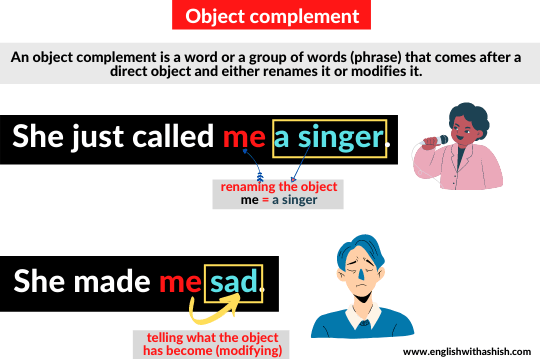
NOTE: an object complement can’t exist in a sentence if it doesn’t have a direct object. And a direct object can only be there in a sentence if the action verb is transitive.
Object complement examples
- The company just made Ron our team leader.
(In this sentence, ‘our team leader’ is the object complement (noun phrase) that renames the object ‘him’. Ron = our team leader ) - Talking to Jane makes me happy.
(Here, the object complement ‘happy’ is an adjective that’s modifying the object ‘me‘. Me = happy)
Nouns as object complement
- Nobody considers him a singer.
- We will name her Amayra.
- She calls her husband Doodoo.
- The students elected him the class monitor.
- You can’t call me your best friend.
- Don’t make him my boss.
In these examples, the object complement is either a noun or a noun phrase (the part colored red). But it can be a noun clause too.
- I will call you whatever I want. (You = whatever I want)
- The company will not make me what I want to be. (I = what I want to be)
Adjectives as object complement
- Do you consider him single?
- I consider Jon highly professional as he does not follow orders properly.
- I found his room very messy.
- They found us sleeping at work.
- They found Jon dead.
- Do you find me good-looking?
- Sharing food makes Joe unhappy.
- You proved me wrong again.
- They colored the room yellow.
A list of Verbs that take object complements
- find
- make
- name
- consider
- color
- elect
- declare
- term
- drive
- get
- knock
- shoot
- brand
- term
- certify
- label
Examples:
- This is driving me crazy.
- Reading that book got him motivated to start his own business.
- Jon knocked him unconscious.
- The police shot him dead.
- It’s unfair to label him incapable without looking at his capabilities.
- The news channels have branded him a traitor already.
- The students termed me the best English teacher.
- Nobody was declared the winner in the match.
- The doctors declared him dead.
NOTE: some verbs take “as” between the object and the object complement.
- They certified me as an English teacher.
- His country labeled him as a traitor.
- Are you branding me as a fighter here?
- The company branded its product as a medicine for cancer.
- Most doctors have declared Coronavirus as the most dangerous virus in history.
Don’t confuse a direct object with an object complement!
Sometimes, students misread a direct object as an object complement. It happens when a verb has two objects: direct and indirect object.
Look at some examples of direct objects:
- They gave me a car on my birthday.
- I will bring you your favorite food.
In both these examples, the verb has two objects: direct and indirect. The direct object (in red) is coming after the indirect object (in bold). But note that the direct object is not referring to the indirect object. They (direct and indirect objects) are not the same person.
On the contrary, an object complement (when it’s a noun) identifies the direct object and renames it. They both are the same person or thing.
- They called me a gifted singer. (me = a gifted singer)
- I will make you the captain of the team. (you = the caption of the team)
Subject complement vs Object complement
A subject complement comes after a link verb. Whereas, an object complement comes after a direct object.
Examples:-
- I am a teacher. (subject complement)
- They made me a teacher. (object complement)
Practice exercise!
Find out the object complement in the following sentences (if any):
- We got him a beautiful gift.
- We got him upset.
- Jon made me his personal trainer.
- Jon made me white sauce pasta.
- She drove me crazy.
- Don’t call me a quitter.
- She is driving me to work.
- We painted the door red.
- His post-fight interview made me upset.
- My friends got me some gifts.
Answers:
- No object complement
- upset
- his personal trainer
- No object complement
- crazy
- a quitter
- No object complement
- red
- upset
- No object complement
Have a question or need deeper clarity? Drop it in the comments — I personally answer your questions/doubts.
If you found this lesson valuable, share it with peers or learners who will benefit. Let’s raise the standard of how we learn English — together.
Looking for personalised coaching to elevate your English, communication, and life skills?
I offer 1-on-1 mentorship that integrates advanced English fluency with emotional intelligence, confidence building, and personality development — designed to help you grow not just as a speaker, but as a powerful individual.
Reach out at [email protected] to get started.
On YouTube and Instagram, we break down real conversations, dive into pop culture, share quick grammar hacks, and do the things your textbook never could.
Follow now — and start learning smarter.

hi,
I am a beginner. I watched your video and read the article on object complement.
In this video, you said that only noun, noun clause, and adjective act as an object complement but I watched others videos in which they said infinitive, participle and prepositional phrase also used. would you please explain me this please.
Hi Ravi,
In both my video and website post, I have mentioned that an object complement shows what the object has become. It shows the state of the object, which is a name (noun) or an adjective (participle or regular adjective).
thank you sir
“Arshdeep became a last over hero to steal a heist for his team.”
“There was a profligate seamer to defend those runs.”
“He bowled the Australian captain with the third ball to seal the match.”
“I permitted him to use my car./I forbade him to enter my building./I ordered him not to play the terrible song.”
What are the role of “to steal, to defend to seal, to use, to enter, to play ?
How are they fitting in the sentences?
Are they infinitives?
Are they Object complement?
Are they Indirect objects?
Are these sentences in reduced form?
Dear Sir,
I am really confused this time. Please Help!!
Correction: Arshdeep became a last over hero by stealing a heist for his team.
1. to defend those runs (adjective to the noun ‘seamer’)
2. to seal the match (adverbial to the verb ‘bowled’)
3. to use my car (direct object of the verb ‘permit’, indirect object = him)
4. to enter my building (direct object of the verb ‘forbade’, indirect object = him)
5. not to play the terrible song (direct object of the verb ‘permit’, indirect object = him)
Thanks, I’m from Bangladesh.
You are welcome, Nazmul.